
Why Most Digital Products Fail (And The 11-Step Formula to Ensure Yours Doesn’t)
If you want to know why most digital products fail, the answer is usually painful but simple: creators build what they want, not what the market is begging for.
I’ve been there. I’ve stared at a dashboard showing $0 in sales after weeks of “grinding.” It feels personal. It feels like the internet is ignoring you. But after analyzing countless failed launches, I realized that failure isn’t bad luck. It’s a pattern.
Most creators are playing the “Field of Dreams” game—if I build it, they will come. But in the digital economy, nobody is coming unless you are solving a specific problem they are already complaining about.
The good news? Once you swap your intuition for data, everything changes. I found my first successful product idea not by brainstorming, but by reading a stranger’s rant on a forum. I built a simple solution to their frustration, launched it, and finally started seeing consistent sales.=
Why Do Most Digital Products Fail?
Quick Answer: Most digital products fail due to reasons such as lack of validation, generic positioning, and perfectionism. Creators often build solutions for “everyone” without verifying if a painful problem actually exists. Success comes from identifying specific market complaints, shipping an imperfect “Version 1.0” quickly, and iterating based on real feedback rather than assumptions.
The “Field of Dreams” Lie: Why Your Opinion Doesn’t Matter
Here is the hardest pill to swallow: Your opinion doesn’t matter. The market’s opinion matters.
We love our ideas. We think they are innovative and necessary. So we retreat into our caves, spend three months building a massive course or eBook, and release it to the world.
And then? Silence.
This happens because you started with a product instead of a problem.
The Research First Strategy
I stopped guessing a long time ago. Now, I listen.
My first winning product didn’t start with a lightbulb moment. It started with research. I was scrolling through a community forum in my niche, sorting threads by “Top” and “New,” looking for negative emotion.
I found users writing furious rants about specific technical struggles. They weren’t just annoyed; they were desperate. I realized I knew how to fix that exact issue. I didn’t spend months building a masterclass. I spent a weekend building a simple, direct fix.
The result? Actual traction and satisfied customers.
To replicate this, stop looking for ideas. Look for complaints.
- Search X (Twitter) for [niche] struggling or [niche] help.
- Read the 1-star and 2-star reviews on Amazon books in your industry.
- Read YouTube comments.
The complaints are your roadmap. If people are actively complaining, they are actively waiting to pay for a solution.
The “Bleeding Neck” Problem Finder AI Prompt
Use this AI prompt template to do deep research and identify opportunities in the market. Copy and paste it into any AI tool with deep research, like Perplexity, ChatGPT, or Gemini Pro. Ensure to add the specifics about your niche:
I am looking for “Bleeding Neck” problems—issues so painful that the market is actively searching for a solution and is willing to pay for it.
Please perform a real-time web search and sentiment analysis across the following sources:
1. Reddit (Focus on top niche subreddits).
2. X (Twitter) (Look for recent complaints/questions).
3. Amazon Best Sellers (Analyze 2, 3, and 4-star reviews—look for “It was good BUT…” comments).
4. YouTube Comments (On the top 3-5 tutorial videos in this niche).
5. Niche-specific Forums or Facebook Groups (if indexable).
Your Research Protocol:
Step 1: Identify “Negative Sentiment Clusters.” Look for keywords like: “overwhelmed,” “confused,” “waste of money,” “stuck,” “too complex,” “I hate,” “why is this so hard,” and “is there an alternative to.”
Step 2: Identify “Gap Signals.” Look for phrases indicating missing solutions, such as: “I wish there was a guide for…”, “Why hasn’t anyone made…”, or “I would pay for…”
Step 3: Output your findings in a structured “Opportunity Report” containing:
Table 1: The Pain Matrix
– Column A: The Specific Struggle (e.g., “Cannot figure out how to import X to Y”).
– Column B: The Emotional Impact (e.g., “Feels stupid, wasting hours, fear of losing client”).
– Column C: The Current “Broken” Solution (What are they using now that fails? e.g., “Spreadsheets that crash,” “YouTube videos that are outdated”).
– Column D: Frequency/Heat (High/Medium/Low based on search volume/discussion density).
Table 2: The “Willingness to Pay” Signals
– List 3-5 specific quotes or threads where users explicitly mentioned spending money or hiring help to solve this.
Summary Strategy:
– Based on the data, recommend 3 specific “Digital Products” ideas (e.g., Templates, Checklists, Mini-Course, etc.) that solve the highest-pain problem found.
The 5 Fatal Mistakes That Make Most Digital Products Fail
After studying the wreckage of failed launches, I noticed the same patterns repeating. If you are struggling, you are likely guilty of at least one of these five mistakes.
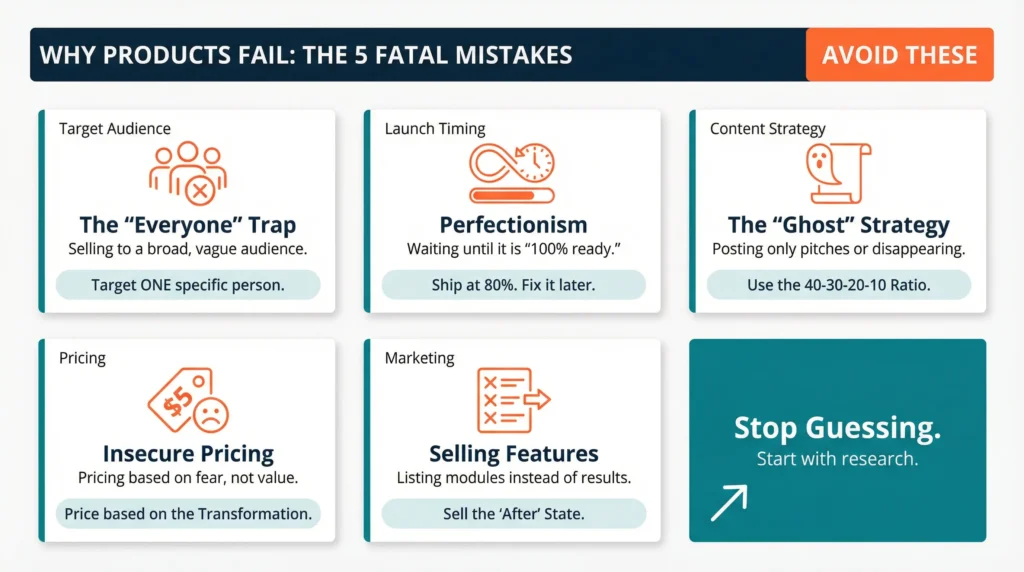
Mistake 1: The “Everyone” Trap
The fastest way to fail is to try to sell to everyone. “Building for everyone is building for no one.”
Struggling creators build products for a “broad audience” with a “vague problem” (e.g., “I want to help people get better at life”). Successful creators solve a specific struggle for a specific person (e.g., “I help freelance designers fix their client onboarding process”).
If you can’t describe your target customer in one sentence, you don’t have a target customer. You have a wish list.
Mistake 2: Perfectionism (Procrastination in a Mask)
“I’ll launch when it’s ready.”
Here is the truth: It will never be ready. Perfectionism is just procrastination wearing a fancy mask.
My first viable product had typos in the first chapter. It still sold. Why? Because the solution worked. I fixed the typos later based on customer feedback.
The Rule: Ship at 80%. The market will teach you how to improve your product faster than your own editing ever will.
Mistake 3: The Ghost Strategy (No Content)
You cannot just post about your product and expect sales. You will get muted. Conversely, you cannot just post “value” without ever selling. You will go broke.
You need a strategy. Use a balanced Content Ratio to build trust without burning out your audience:
- 40% Teaching: Actionable advice related to what you sell.
- 30% Stories: Your journey, failures, and lessons.
- 20% Engagement: Opinions, questions, and interactions.
- 10% Selling: Actual product mentions and pitches.
The 90% that isn’t selling is what earns you the right to post the 10% that does.
Must Read: The Blueprint for Easy AI Side Hustle: Building Digital Products for Passive Income
Mistake 4: Pricing Based on Insecurity
Many creators price their products based on how much they feel they are worth, rather than the value of the problem they solve. They charge $5 for something that saves the customer $500 worth of time.
When you price too low, you attract customers who don’t take the work seriously, and you signal that your product isn’t valuable. Price is based on the transformation, not your insecurity.
Mistake 5: Selling Features, Not Transformations
Customers do not buy “20 hours of video content.” They do not buy “50 PDF worksheets.”
They buy the result.
If you are marketing your product by listing how many modules it has, you are doing it wrong. You must market the “After State.” Who will they be after they finish your product? Sell the destination, not the plane ride.
Winners vs. Losers: The Digital Product Breakdown
Which column are you currently operating in? Be honest.
| Feature | The Struggling Creator | The Scaling Creator |
| Audience | Broad (Everyone) | Specific (One type of person) |
| Problem | Vague (General improvement) | Specific (One clear struggle) |
| Format | Bloated (Complex & Long) | Simple (Solves it quickly) |
| Positioning | Invisible (Same as everyone else) | Clear (Unique Mechanism) |
| Proof | “Trust me, bro.” | Social Proof (Testimonials) |
| Consistency | Random (When inspired) | Daily (Discipline) |
| Commitment | Impatient (Quits after 3 weeks) | Patient (6+ month commitment) |
Related Reading: How to Use AI to Find a Profitable Digital Product Niche
How to Diagnose a Dying Product (The Metrics Check)
If your product isn’t selling, don’t throw the whole thing away. Digital marketing is a machine with distinct parts. You need to find the broken part.
Use this diagnostic list to fix the bottleneck, not the product:
- CPC (Cost Per Click) is too high? → You have a Creative Problem. Your visuals aren’t stopping the scroll.
- CTR (Click Through Rate) is low? → You have a Hook Problem. Your headline isn’t grabbing attention.
- Conversion Rate is low? → You have a Landing Page Problem. You aren’t communicating the value clearly enough.
- AOV (Average Order Value) is weak? → You have an Offer Problem. You aren’t bundling or pricing correctly.
- Results are volatile? → You have no Identity Targeting. You aren’t reaching a specific enough audience.
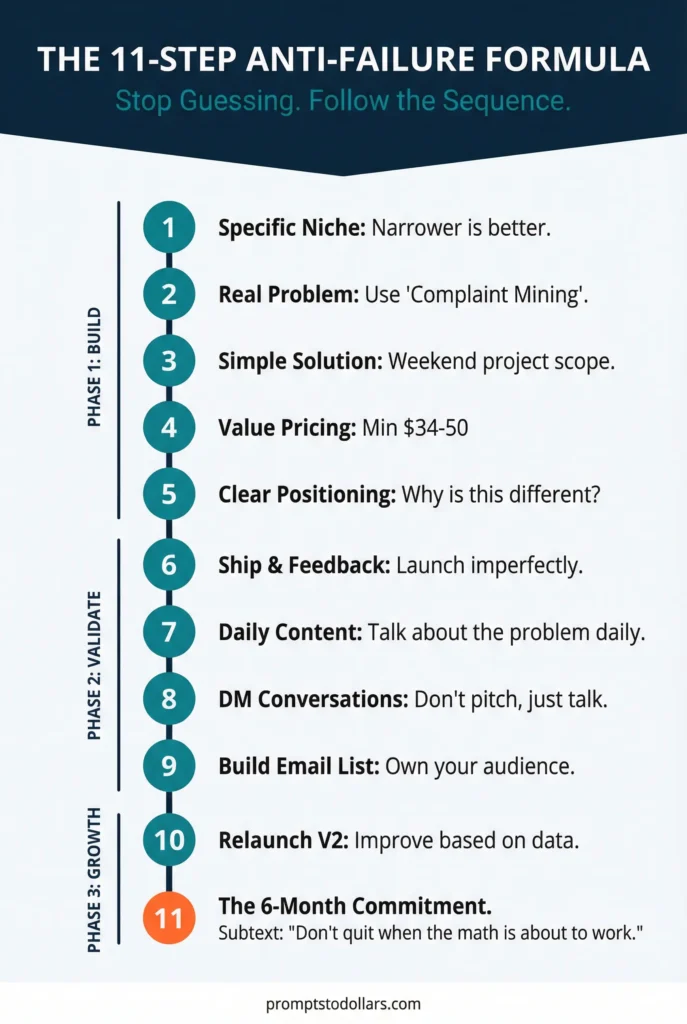
The 11-Step “Anti-Failure” Formula
Stop overcomplicating it. This is a logical sequence to minimize risk.
- Pick a specific niche. (Narrower is usually better.
- Find a REAL problem. (Use the Search/Forum strategy mentioned earlier.
- Create a simple solution. (Keep the scope small for V1).
- Set the Price. Do not underprice your value; aim for a sustainable margin.
- Position Clearly. Define exactly why your solution is different.
- Launch & Collect Feedback. Do this early.
- Post Daily. Talk about the problem you solve every single day.
- DM Engaged Followers. Start conversations, don’t just pitch.
- Build an Email List. Social media is rented land; email is owned land.
- Relaunch with Improvements. Use the feedback to make V2.
- Don’t Quit for 6 Months.
Most people quit in Month 1 when sales are slow. Real traction often happens between Month 6 and Month 12. You are comparing your Week 2 to someone else’s Year 2. Stop.
People Also Read: How to Make Money with AI: The Ultimate & Proven Beginner’s Guide
Conclusion: Which Column Are You In?
I don’t want to summarize what you just read. You know what you need to do. The only question left is whether you have the patience to actually do it.
The gap between the “Struggling” column and the “Scaling” column isn’t talent. It isn’t luck. It is simply the ability to withstand the silence of the first few months.
Remember the timeline reality:
- Month 1: You are learning.
- Month 6: You are getting traction.
- Month 12: You are scaling.
If you quit in Month 2 because you “only” made a few sales, you aren’t failing—you are quitting right before the math starts to work in your favor.
Go back to the Winners vs. Losers table above. Pick one trait from the “Struggling” column that you are currently guilty of (like “Random Posting” or “Pricing based on insecurity”). Fix that one thing today.
Then, do it again tomorrow.
People Also Ask (FAQ) on Why Most Digital Products Fail
Why do most digital products fail?
Most digital products fail because they solve a problem that doesn’t exist. Creators often prioritize their own ideas over market demand. If you cannot find active complaints about a specific problem on social media or forums, there is likely no market for the solution.
How do I validate a digital product idea before building it?
Validate your idea by “complaint mining.” Search Reddit, X (Twitter), and Amazon reviews for keywords like “struggling with” or “hate.” If you find consistent complaints, create a simple outline or “Waitlist” landing page. If people give you their email address, you have validation.
What is a good conversion rate for digital products?
The industry average conversion rate for an email list is typically between 2% and 5%. However, creators who write personal, story-driven emails (rather than corporate newsletters) often see conversion rates significantly higher because trust drives sales more than copywriting tricks.