

15 Realistic Ways to Turn AI Prompts into Income: A Comprehensive Guide
If you’re reading this, you’re sitting on a goldmine. It’s not oil, but the ability to talk to a computer using natural language and turn those AI prompts into income.
Every time you feed ChatGPT, Gemini, or Midjourney a killer prompt, you’re not “just playing with AI” – you’re quietly minting a digital asset.
Most people use it once, toss it, and walk away from money they’ve already created.
Meanwhile,Grand View Research reports that the market for AI prompts is projected to explode from $1.4 billion to a staggering $11 billion by 2033. This is a 25.9% compound annual growth rate.
This guide shows you exactly how to grab your share. If you’re ready to stop dabbling and start earning, keep reading.
- To turn AI prompts into income, you must dominate a specific niche, as the market for generic “100 ChatGPT prompts” packs is oversaturated and no longer profitable.
- The highest profits come from selling outcomes, not just prompts; a complete system like a “Notion Content Dashboard” can command 10x the price of a simple text file.
- Real wealth is made in B2B, where you can charge $2,500 for a single corporate workshop or secure $5,000+ monthly retainers for “Prompt-as-a-Service” consulting.
- The fastest path to profit is climbing the “Prompt-to-Profit” hierarchy, graduating from low-margin marketplace sales to building high-value, automated software systems.
- With the market projected to hit $11 billion by 2033, your first $1,000 is realistically achievable within 90 days by following a validated action plan focused on solving one problem for one audience.
The Prompt-to-Profit Hierarchy: 4 Levels of Monetization
Before we enter the rabbit hole, you need to understand the landscape. Making money with AI prompts isn’t a flat, one-size-fits-all game. It’s a ladder. The higher you climb, the more you earn, and the more defensible your business becomes.
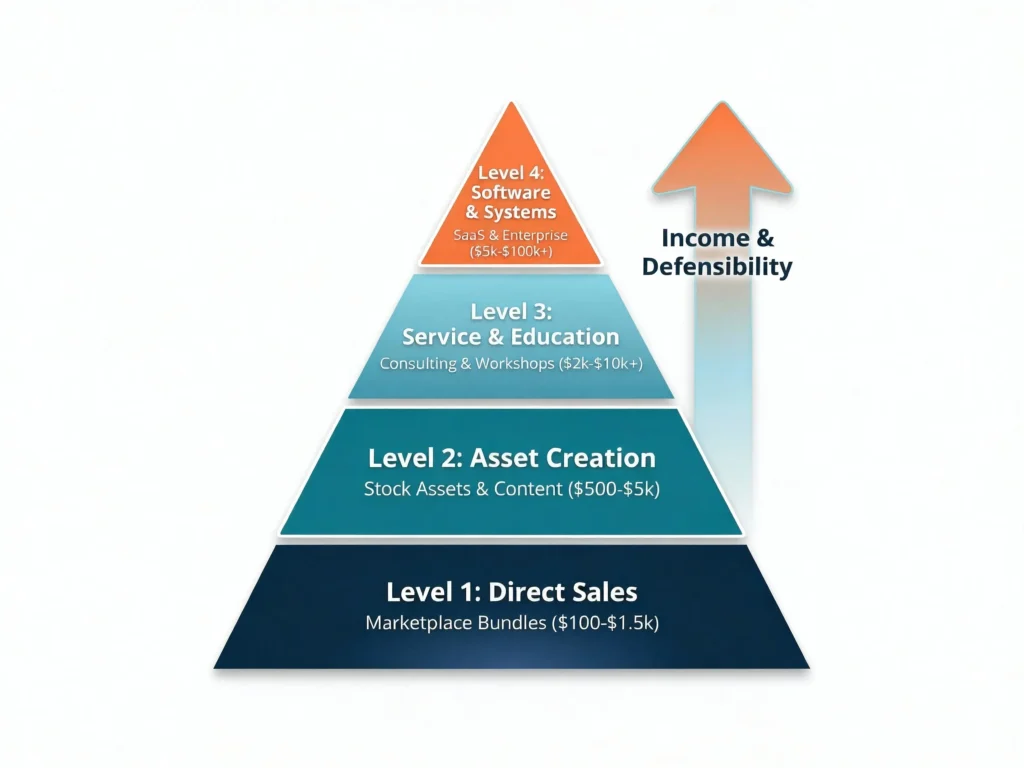
Here’s the framework we’ll use. Find yourself, then find your next step.
| Level | Strategy Focus | Effort | Startup Cost | Possible Earnings (Monthly) |
|---|---|---|---|---|
| Level 1 | Direct Sales | Low | Low | $100 – $1,500 |
| Level 2 | Asset & Content Creation | Medium | Low | $500 – $5,000 |
| Level 3 | Service & Education | Medium-High | Medium | $2,000 – $10,000+ |
| Level 4 | Software & Systems | High | Medium-High | $5,000 – $100,000+ |
Here is a quick intro about each level:
- Level 1 (Direct Sales): This is the entry point. You’re selling the raw material—the prompt text itself—on various marketplaces. It’s the fastest way to get your first dollar.
- Level 2 (Asset & Content Creation): Here, you move from selling the recipe to selling the cake. You use your prompts to create other digital assets (art, books, content) and sell those.
- Level 3 (Service & Education): Now you’re the expert. You’re either teaching others your hard-won skills or performing high-value services for clients using your private prompt library. This is where your income starts to climb seriously.
- Level 4 (Software & Systems): This is the endgame. You wrap your prompts into scalable, automated systems like micro-SaaS apps, APIs, or licensed enterprise solutions. This is where you build true, life-changing wealth.
Now, let’s break down exactly how to dominate each level.
Level 1: Direct Sales Strategies (How to Monetize AI Prompts for Beginners)
This is where you cut your teeth. The goal is speed to market and market validation. You learn what people will actually pay for.
Don’t underestimate this stage. The lessons you learn here are the foundation for everything that follows.
1. Niche Bundle Strategy: Selling Prompts on Gumroad & Etsy
The Uncomfortable Truth: Nobody wants to buy a single prompt. They want a solution to a problem.
Generic prompts like “write an email” are worthless. But a bundle of “50 Cold Email Prompts for SaaS Sales Reps Targeting CTOs”? That’s a product.
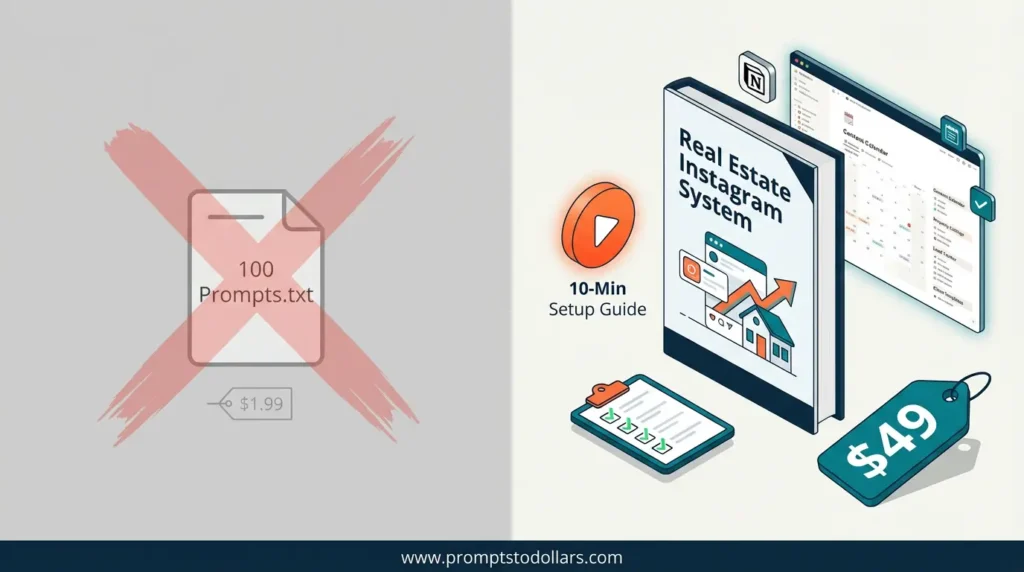
Why It Works: Buyers crave a complete toolkit, not a single tool. They’re paying for convenience and expertise. By bundling, you increase the perceived value exponentially. A single prompt might be worth $1, but a pack of 50 is worth $19, $49, or even $99.
Actionable Steps:
- Identify a Hungry Micro-Niche: Don’t target “marketers.” Target “Shopify store owners in the skincare niche.” Get specific. Look at job boards, Reddit communities (r/smallbusiness, r/freelance), and Amazon book categories to find desperate buyers.
- Create a “Solution Stack”: Your bundle should solve a multi-step problem. For our Shopify owner, a bundle could include prompts for:
- Product Descriptions
- Instagram Captions
- Email Newsletters
- Facebook Ad Copy
- Package It Beautifully: Use a free Canva account to create an attractive cover image and a clean PDF. Presentation matters. On Etsy, this is non-negotiable. They love designed digital products, not raw text files. Call them “MidJourney Cheat Sheets for Interior Designers” or “ChatGPT Prompt Cards.”
- Price for Value, Not by the Word: A common mistake is pricing too low. One seller told me about making a paltry $492 from 620 sales at $0.99. His painful lesson? “Price at $4.99 minimum. The 99¢ experiment attracted bargain hunters who refunded at the first hiccup.” A good starting point for a quality niche bundle is $19 – $49.
- Choose Your Platform:
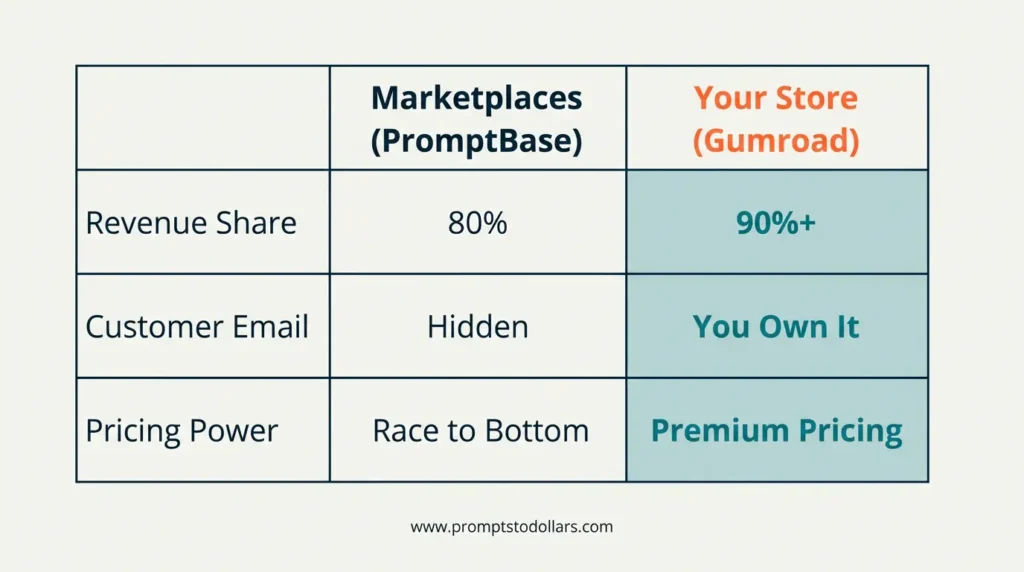
- Gumroad/Payhip: Best for beginners. You get a higher percentage of the sale (90%+) and can build a direct email list.
- Etsy: Great for visual niches (art, design, crafts). The platform has a massive built-in audience but takes a larger cut.
Possible Earnings: $100 – $1,500/month once you have at least 3 strong, niche AI prompt bundles. I have seen friends hit $14,000 in six months using this exact strategy.
2. Specialized Marketplaces: How to Win on PromptBase & PromptHero
The Insider Secret: These platforms are not just stores. They are search engines for people with cash in hand, who are actively looking for your product.
While general marketplaces like Etsy or Gumroad are great, dedicated AI prompt marketplaces like PromptBase, PromptHero, and ChatX put you directly in front of the most qualified buyers on the planet.
Visit this article to read more about the best marketplaces to sell your prompts.
Why It Works: You’re fishing in a stocked pond. The audience is targeted, savvy, and ready to buy. Competition exists, but so does massive demand.
On PromptBase, you can sell prompts for models like GPT-image, Midjourney, Stable Diffusion, NanoBanana, keeping 80% of the revenue.
Actionable Steps:
- Build Your Reputation First: This is critical. Start by publishing at least two free items that achieve a 4+ star rating before you can list paid prompts. This strategy forces quality and builds trust.
- Analyze the “Best Sellers”: Don’t guess what sells. Go to the marketplace, filter by “Top Rated” or “Most Popular,” and study the winners. What niches are they in? How are their titles structured? What do their descriptions include? Reverse-engineer success.
- Focus on Visual & Complex Prompts: Simple text-generation prompts are harder to sell. The real money is in sophisticated Midjourney prompts that create stunning, unique art styles, or intricate ChatGPT prompts that generate code, complex tables, or entire specific content or documents.
- Write Killer Descriptions: Don’t just paste the prompt.
- Show, don’t tell. Include high-quality example outputs.
- Explain how to use the prompt and how to modify it.
- Use keywords in your title and description that buyers are searching for (for example, “Cyberpunk Character Art,” “Watercolor Animal Portraits,” “SEO Blog Outline Generator”).
Possible Earnings: Top sellers on these platforms are quietly pulling in from $1,000 to over $5,000 per month. It takes time to build a portfolio, but the potential for passive income is enormous.
3. Notion Templates: Integrating AI Prompts for Passive Income
The Big Idea: Stop selling a text file. Start selling an interactive system.
Notion has become the go-to “second brain” for millions of professionals. When you embed your AI prompts directly into a well-designed Notion template, you’re not just selling a prompt; you’re selling an entire productivity workflow.
Why It Works: You’re dramatically increasing the perceived value. A text file of prompts is a commodity. A “Content Creation Dashboard” in Notion, complete with a content calendar, project trackers, and embedded custom AI prompts, is a high-value, premium product.
Actionable Steps:
- Find a Workflow to Automate: What tedious process can you streamline?
- A freelancer’s client onboarding system.
- A YouTuber’s video production pipeline.
- A student’s research and note-taking dashboard.
- Build the Template in Notion: Create the databases, pages, and structure of the workflow.
- “Infuse” with Prompts: For each step in the workflow, create a corresponding AI prompt. For the YouTuber template, you might have prompts for:
- “Generate [X] Viral Video Titles for [Topic].”
- “Write a Script Outline for [Title].”
- “Create [X] YouTube Tags and a Video Description for [Script].”
- Market it as a System: Sell it on Gumroad or your own website. Don’t call it “Notion Prompts.” Call it “The Ultimate Content Automation Hub” or “The Freelancer’s OS.” You’re selling a transformation, not a template.
- Price Accordingly: While a simple prompt pack might sell for $10, a comprehensive Notion system can easily command $49, $79, or even $149.
Possible Earnings: $1,000 – $7,000/month. This is a red-hot market, and creators who blend Notion skills with prompt engineering are cleaning up.
4. The “Lead Magnet” Funnel: Using Free Prompts to Sell High-Ticket Offers
The Professional’s Play: The prompt is not the product. The prompt is the advertisement for the real product.
This is a classic direct-response marketing strategy adapted for the AI age (like a comment-to-DM strategy). You give away your best “appetizer” for free to build an audience, and you can sell your “main course” later.
Why It Works: A high-value prompt is one of the best business cards. It instantly demonstrates your expertise and builds trust. By exchanging a valuable prompt pack for an email address, you are building your most valuable asset: a direct line of communication with people who have already raised their hand and said, “I’m interested.”
Actionable Steps:
- Create an Irresistible Freebie: It can’t be generic. It has to be a “golden nugget.” Examples:
- “The Viral LinkedIn Post Generator.”
- “My Top 10 Nano Banana Prompts for Creating Photorealistic Portraits.”
- “The ‘Never Get Rejected Again’ Cold Email Prompt.”
- Set Up a Simple Landing Page: Use a tool like Carrd, Gumroad (set price to $0+), or ConvertKit to create a simple page where people can enter their email to get the freebie.
- Promote the Freebie Everywhere: Share it on Twitter/X, LinkedIn, Reddit, Facebook groups, and relevant forums. Don’t just drop a link. Show the results. Post a screenshot of the viral LinkedIn post your prompt generated. Share the photorealistic portrait.
- Nurture Your Email List: Once they’re on your list, don’t just hammer them with sales pitches. Send them more value. Share more tips, case studies, and insights.
- Sell the High-Ticket Offer: After building trust, you can sell your premium products:
- A comprehensive, $297 online course.
- A $500/month consulting retainer.
- A $1,500 weekend workshop.
Possible Earnings: The earnings from the prompt itself are $0. The earnings from the backend funnel can be limitless. This is how you transition from making side-hustle money to building a real business with AI prompts.
Level 2: Asset Creation (Making Money with AI Art & Content)
Here, you stop selling the shovel and start selling the gold you dig up with it. You use your expert prompting skills to generate high-value digital assets that people are already buying every single day. The margins are fantastic, and the work is a lot more creative.
5. Sell AI-Generated Art & Stock Assets in Bulk
The Opportunity: The world needs more than just “cyberpunk warriors.” It needs high-value products such as textures, icons, patterns, mockups, and the like.
While everyone is trying to sell one-off “AI art” prints, the real commercial opportunity is in “asset farming.” This means using your prompts to generate commercial-use assets that designers, marketers, and businesses desperately need.
Why It Works: You’re serving a B2B market, which has deeper pockets and a constant need for new creative assets. They don’t care that it was made with AI. They only care that it solves their problem quickly and affordably.
Actionable Steps:
- Think Like a Designer, Not an Artist: What do they actually use?
- Seamless textures (wood, marble, concrete, fabric)
- Isolated 3D icons for websites and presentations
- Vector-style flat illustrations for blog posts
- Product mockups (e.g., “a white coffee mug on a marble countertop”)
- Thematic sticker sheets
- Master the “Commercial” Prompt: Your prompts need to be precise. Use terms like: —style raw, flat vector illustration, isolated on white background, seamless pattern, 4k photorealistic.
- Generate in Bulk and Curate Ruthlessly: Create 200 or more variations of a single asset type (e.g., “gold foil textures”). Throw away the 100 mediocre ones and keep only the 100 absolute best. Quality is everything.
- Upscale and Package: Use an AI image upscaler tool like Magnific AI to ensure your images are high-resolution. Package them into logical ZIP files (e.g., “100 Gold Foil Textures,” “100 Isometric Tech Icons”).
- Sell Where Designers Shop:
- Creative Market / Envato Elements: These are the premier marketplaces for design assets.
- Adobe Stock: Has a massive user base through the Creative Cloud ecosystem.
- Etsy: Great for more craft-oriented assets like digital paper and sticker sheets.
Possible Earnings: This can start as a slow burn, but a solid portfolio of 10-20 high-quality asset packs can generate $500 – $3,000+ per month in passive income.
6. Amazon KDP: Publishing Low-Content Books with AI Prompts
The KDP Hack: Amazon’s Kindle Direct Publishing (KDP) is a print-on-demand machine. You upload a PDF, and Amazon handles the printing, shipping, and customer service. The “low-content” book market (journals, planners, logbooks) is huge, and AI puts it on steroids.
Why It Works: You can use AI to generate the interior content of these books in minutes, not months. This allows you to rapidly test niches and publish dozens of books with minimal effort.
Actionable Steps:
- Brainstorm Niche Book Ideas: Go beyond the obvious “lined journal.” Think of books that require unique, generated content. Consider these examples:
- A book of “1,000 Creative Writing Prompts for Sci-Fi Authors.”
- A “Daily Stoic Affirmations Journal.”
- An activity book for kids with AI-generated coloring pages, mazes, or word searches.
- A “Cocktail Recipe Book” with AI-generated recipes and illustrations.
- Craft a “Generator” Prompt: Create a prompt that can be run repeatedly to generate the pages of your book. For example: Generate a unique, intricate mandala coloring page for adults, with clean lines and great detail. Run these 20 or more times.
- Compile Your Book: Use a simple tool like Canva or Book Bolt to assemble your generated pages into a print-ready PDF. Design an eye-catching cover (you can use an AI image generator like Nano Banana).
- Publish on Amazon KDP: Upload your cover and interior files, write a keyword-rich title and description (e.g., “100 Unique Mandala Coloring Pages for Stress Relief and Mindfulness”), and set your price.
- Rinse and Repeat: The key to KDP success is volume and niche testing. Don’t fall in love with one book. Publish, see what sells, and double down on the winning niches.
Possible Earnings: A single successful book can make $100 – $500 per month. An author with a portfolio of 20-30 niche books can earn $ 2,000-$8,000+ per month. More books now list ChatGPT or other AI tools as the co-author on KDP. The opportunity is proven.
7. Content Monetization: YouTube, Social Media & Blog “Prompt Teardowns”
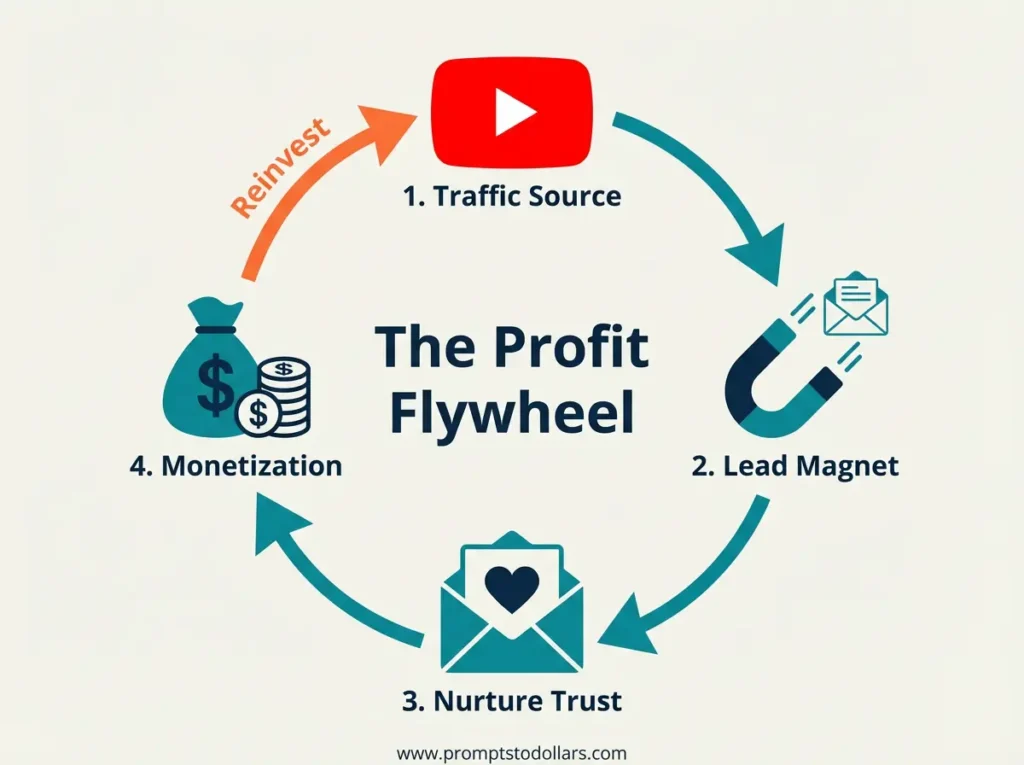
The Authority Play: Instead of just selling prompts, you teach the art and science behind them. You become the go-to expert, and monetization follows naturally.
Why It Works: People are desperate to improve their prompting skills. YouTube is the #2 search engine in the world, and “how to use AI prompts” is a popular query. By creating high-value educational content, you attract a massive, engaged audience.
Actionable Steps:
- Choose Your Format:
- Prompt Teardowns: Analyze why a famous or viral prompt works so well. Break it down line by line.
- “From Prompt to Product”: Show the entire workflow on screen, from crafting the initial prompt to listing the final product on platforms like Etsy or KDP.
- Case Studies: Show how you used a specific prompt to achieve a measurable result (e.g., “This Prompt Got Me 10,000 Views on LinkedIn”).
- Be Consistent: Aim for high-quality videos, blog, or social media posts per week. Consistency is more important than production value in the beginning.
- Monetize Multiple Streams: This is where it gets powerful.
- Gumroad/Patreon: Link to your own prompt packs and templates in every video description. A creator who makes a “From Prompt to Etsy Listing” video is likely to see higher conversion rates for their paid products.
- YouTube Ad Revenue: Once you hit the monetization threshold, you get paid for views.
- Affiliate Marketing: Include affiliate links for the AI tools you use (ChatGPT Plus, Midjourney, Jasper). You can earn 20-40% recurring commissions.
- Sponsorships: Once you have a decent audience (5,000+ subscribers), AI tool companies will pay you to feature their products.
Read More about AI Tools with Affiliate Programs You Can Join to Generate Income
Possible Earnings: A channel with 10,000 engaged subscribers can easily generate $1,000 – $5,000+ per month from this combination of income streams. The trick is to diversify your channel’s income streams beyond just AdSense. Ad revenue alone typically yields much less.
Level 3: Service & Education (High-Ticket AI Consulting)
You’ve mastered the tools. You’ve seen what works. Now, it’s time to stop selling your products for $49 and start selling your time and expertise for thousands. This is the fastest path to a six-figure income.
8. Offer “Productized” Freelance Services (Instead of your Time)
The Paradigm Shift: Stop selling hours. Start selling outcomes.
A “productized service” is a freelance service with a defined scope, a fixed price, and a predictable timeline. You use your private library of optimized prompts to deliver high-quality work at lightning speed.
Why It Works: Clients don’t want to pay for your time. They are looking for results. They are happy to pay a premium for speed and quality. You can charge $1,000 for a project that takes you hours, thanks to your AI leverage.
Actionable Steps:
- Identify a High-Value, Repeatable Service: What can you deliver consistently?
- “10 SEO-Optimized Blog Posts in 48 Hours.”
- “A Complete Social Media Content Calendar for One Month.”
- “20 High-Converting Product Descriptions for Shopify Stores.”
- Build Your “Prompt Stack”: For each service, develop a series of optimized prompt templates and workflows that handle 90% of the work. For the blog post service, you’d have prompts for:
- Keyword research and outline generation.
- Drafting each section.
- Writing meta descriptions and social media snippets.
- Set a Premium Price: You’re not charging by the hour. You’re charging for the value and speed you provide. If 10 blog posts would normally cost a client $2,000 and take two weeks, your offer of $1,000 in two days is a steal.
- Market Your Service:
- Upwork/Fiverr: Create high-end gig packages.
- LinkedIn and X: Post case studies and results to attract inbound leads.
- Cold Outreach: Directly contact businesses in your niche that could benefit from your service.
Possible Earnings: A single freelancer can realistically handle 2-4 of these productized service packages per week. At $1,000 per package, you’re looking at $8,000-$16,000 per month.
9. Corporate Training: Running Prompt Engineering Workshops
The Hidden Goldmine: Companies are desperate to use AI, but they’re also terrified of data leaks, bad outputs, and looking stupid. They will pay handsomely for an expert to come in and show their team how to use it effectively and safely.
Why It Works: They don’t want a generic Udemy course. They want someone to solve their specific problems. You’re not just a teacher; you’re a consultant who provides a turnkey solution.
Actionable Steps:
- Niche Down by Department: Don’t offer “ChatGPT Training.” Offer:
- “A Prompt Engineering Workshop for HR Teams.”
- “AI-Powered Content Strategy for Marketing Departments.”
- “Streamlining Sales with AI for B2B Sales Teams.”
- Create a “Workshop-in-a-Box”: Your offering should include more than just a lecture.
- A 2-4 hour live, interactive workshop (virtual or in-person).
- A custom “Prompt Pack” specifically designed for that department’s tasks (for example, writing job descriptions, performance reviews, sales scripts).
- A “Best Practices & Governance” document to help them use AI safely.
- Find Clients:
- LinkedIn: Search for “Head of HR” or “VP of Marketing” at mid-sized companies (50-500 employees) and connect with a personalized message.
- Local Chamber of Commerce / BNI Groups: Networking is incredibly effective for landing local corporate gigs.
- Price for Corporate Budgets: Do not undercharge. A half-day workshop for a team of 10 is easily worth $2,500 – $7,500. You are solving a major business problem and potentially saving them hundreds of hours of work.
Possible Earnings: Landing just two of these workshops a month can generate $5,000 – $15,000. Top AI consultants are billing this out weekly.
READ MORE: Make Money with AI in 2026: Ultimate Beginner Guide
10. Create an “Outcomes-Based” Online Course or Certification
The Education Revolution: The demand for prompt engineering skills is exploding. Job postings mentioning the skill grew by 180% in the past year. People will pay for credentials that can get them a raise or a new job.
Why It Works: Don’t sell “learning.” Sell a transformation.
Your free YouTube videos can see a 15% completion rate. Your paid, cohort-based courses that promise a specific outcome (that is, in prompt engineering) can see 60%+ completion rates because people are financially and psychologically invested.
Actionable Steps:
- Promise a Tangible Outcome:
- Don’t: “Learn Prompt Engineering.”
- Do: “Build 5 Automated Business Workflows in 30 Days.”
- Do: “Go From Zero to Your First $1,000 Selling AI Art in 6 Weeks.”
- Structure as a Cohort-Based Course (CBC): Instead of a self-paced video library, run it as a live, 4-6 week “bootcamp” with a group of students. This creates accountability, community, and urgency, allowing you to charge a premium.
- Stack the Value: Your course should be more than just videos.
- Price for the Transformation: A high-quality CBC can be priced from $99 to $2,500 per student. If you are helping them get a job that pays $85,000/year, the value proposition is a no-brainer.
Possible Earnings: A cohort of 20 students at $497 each is nearly $10,000 for a 4-week course. Running these quarterly can easily become a multi-six-figure business.
11. B2B Retainers: Offering “Prompt-as-a-Service” Consulting
This is the holy grail of consulting. You’re not just doing a one-off project. You’re becoming a company’s outsourced “AI Prompt Librarian,” ensuring their entire organization is using AI efficiently and consistently.
Why It Works: 68% of organizations cite a “lack of internal expertise” as their #1 barrier to AI adoption. They need ongoing support, and they will pay a premium for a reliable expert to manage it all.
Actionable Steps:
- Start with a Prompt Audit: Offer a one-week, fixed-price audit ($1,500 – $3,000). Analyze their current workflows and prompts, identify inefficiencies, and present a report with your recommendations. This is your foot in the door.
- Propose a Monthly Retainer: Based on the audit, propose a retainer package. Your services could include:
- Monthly Prompt Updates: Continuously refining and updating their core prompts as AI models evolve.
- Team Training: Onboarding new employees and upskilling existing ones.
- Performance Tracking: Creating dashboards to show the ROI of their AI usage.
- Governance & Security: Managing their private prompt library using tools like PromptHub or Portkey.
- Price Based on Company Size and Complexity:
- Small Business (10-50 employees): $1,500 – $3,000/month
- Mid-Market (50-250 employees): $3,000 – $8,000/month
- Enterprise: $10,000+/month
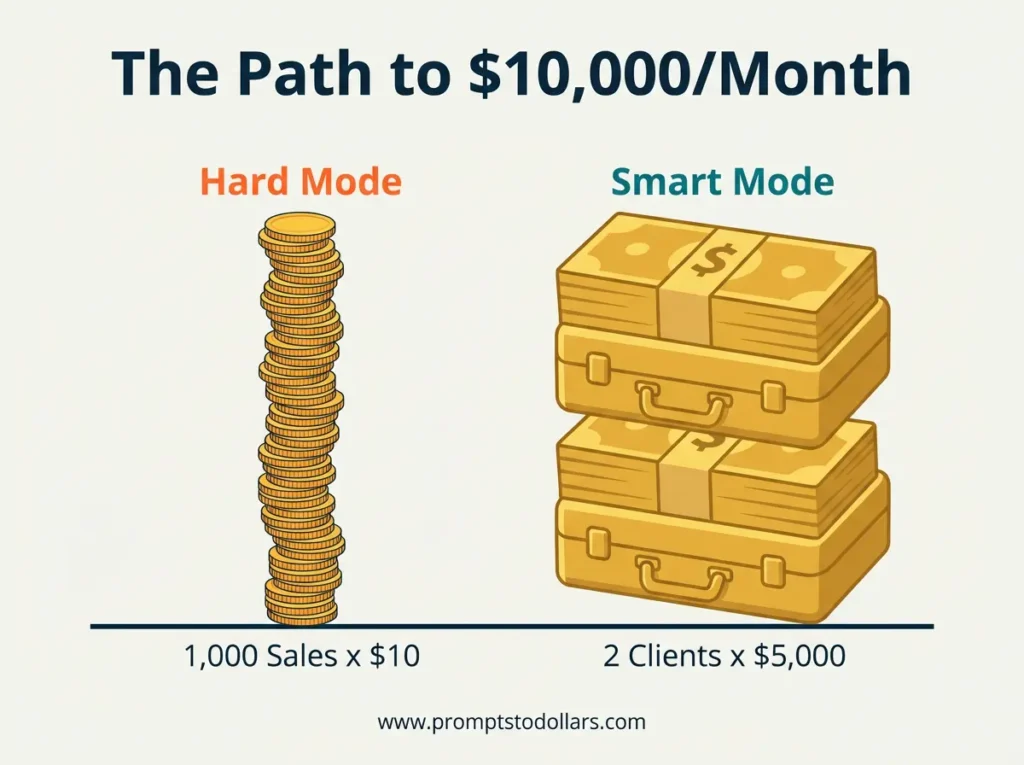
Possible Earnings: Top AI consultants on retainer are billing $150 – $400 per hour. A handful of retainer clients can create a stable, highly profitable $200,000 – $500,000 per year business with surprisingly few billable hours.
Level 4: Software & Systems (Automated AI Revenue Models)
Welcome to the top of the mountain.
This is where you stop trading your time for money entirely. You build automated systems that work for you 24/7, generating scalable, recurring revenue. It requires more upfront work, but the payoff is true financial freedom.
12. Micro-SaaS: Building No-Code AI Wrapper Apps
The Billion-Dollar Secret: The average person can be intimidated by ChatGPT’s blank canvas. They prefer a simple form with fields like “Topic,” “Tone,” and “Length.” You can build this.
A “prompt wrapper” is a simple web application that puts a user-friendly interface (UI) over your powerful, complex prompts.
Why It Works: You’re selling a tool, not a prompt. This immediately elevates its value and allows you to charge a recurring subscription fee. True SaaS businesses can see 80-90% gross margins.
The CRITICAL Warning ⚠️: Do not just build a pretty HTML form that passes data to the LLM API. This is a “thin wrapper” and has no defensible moat. Your app MUST add value beyond the prompt itself. This includes:
- Data Persistence: Saving user generations and allowing them to edit and organize them.
- Workflow Integration: Think of features like allowing automatic posting of generated content to social media via other APIs.
- Team Collaboration: Allowing multiple users to share a prompt library and results.
- Analytics: Showing users which of their generations perform best.
Actionable Steps:
- Start with No-Code Tools: You don’t need to be a programmer. Tools like Lovable, Bubble.io, Emergent.sh, or FormWise allow you to build functional web apps with natural language or drag-and-drop interfaces.
- Find a Painful Niche Problem:
- A tool that generates perfectly formatted legal notices.
- An app that creates real estate listing descriptions and posts them to Zillow.
- A platform that generates a week’s worth of social media content and schedules it.
- Launch with a Simple Subscription: Use a service like Stripe or Paddle to handle payments.
- Pro Plan: $29/month for 100 generations.
- Team Plan: $99/month for 5 users and a shared library.
- Market to Your Niche: Go to the communities where your target users live and show them how your tool saves them time and makes them money.
Possible Earnings: Even a simple Micro-SaaS with 200 subscribers paying $49/month is nearly $10,000 per month in high-margin, recurring revenue.
13. Custom GPTs: Building & Monetizing Private AI Agents
While the public GPT Store is interesting, the real money is in building private, custom GPTs for businesses that are pre-trained on their data.
Why It Works: Businesses want an AI assistant that knows their products, policies, and customers. They need someone to build and maintain it.
Actionable Steps:
- Identify a Data-Intensive Problem:
- A company’s customer support team needs an AI that can answer questions based on their 500-page PDF manuals.
- A law firm wants an AI that can review documents based on their internal case history.
- Build the Custom GPT: Use OpenAI’s tools to create a new GPT. In the Knowledge section, upload the company’s private documents (PDFs, DOCX, CSVs). Craft the “Instructions” to define its persona and tasks.
- Charge a Setup Fee + Maintenance:
- Setup Fee: $500 – $2,000 to build and configure the initial GPT.
- Monthly Maintenance Fee: $250 – $1,000/month to keep the knowledge base updated, refine the prompts, and monitor performance.
Possible Earnings: This is a fantastic, high-leverage service. 5 clients on a $500/month maintenance plan is $2,500 per month for what might only be a few hours of work.
14. White-Label Licensing: Selling Prompt Libraries to Enterprises
The “Picks and Shovels” Play: During a gold rush, sell shovels.
Marketing agencies, SaaS companies, and other B2B firms want to offer AI tools to their clients, but they don’t have the in-house prompt engineering talent. You can sell them the “engine” for their products.
Why It Works: You’re selling one asset to many buyers. You build a massive, high-quality library of prompts once, and then license access to it over and over again.
Actionable Steps:
- Curate an “Agency-Grade” Prompt Library: This needs to be your life’s work. A library of 1,000+ masterfully crafted prompts, organized by industry and use case (e.g., “Marketing Agency Pack,” “Real Estate Agency Pack”).
- Build a Simple API: Work with a developer (or use a tool like Replicate) to create a simple API that other businesses can use to access your prompts.
- Set Up Licensing Tiers:
- Agency License: $250/month for an agency to use the prompts for their client work.
- White-Label SaaS License: $1,000 – $5,000/month for a SaaS company to integrate your prompts into their own product.
- Sell Directly to Decision-Makers: This is a B2B sales process. You’ll be cold-emailing, networking on LinkedIn, and demonstrating your library’s value to agency owners and CTOs.
Possible Earnings: This is an enterprise-level play. Just a few large clients can result in $10,000 – $50,000+ per month in recurring licensing fees. Enterprise prompt management platforms like Portkey are processing 10 billion LLM requests a month on this model.
15. Develop and Sell a “Prompt Wrapper” Browser Extension
The Viral Loop: Browser extensions that solve a real problem can spread like wildfire. An extension that injects your powerful prompts directly into the user’s workflow (in ChatGPT, Gmail, LinkedIn, etc.) is incredibly valuable.
Why It Works: It has a high viral coefficient (often greater than 1.0). Users share it because it genuinely makes their lives easier. You can reach tens of thousands of users in a month.
Actionable Steps:
- Build with an Extension Framework: Use a modern framework like Plasmo to build your extension with React.
- Adopt a Freemium Model: This is key to virality.
- Free Tier: Offers a pack of 20 essential prompts for free. This gets people hooked.
- Premium Unlock: Charge a $19 one-time fee to unlock your full library of 500+ advanced prompts.
- Launch on the Chrome Web Store: The store has a built-in audience. Write a great description, get some initial positive reviews, and your extension can climb the ranks.
Possible Earnings: With a 2-5% conversion rate from free to paid, an extension with 10,000 free users can generate $3,800 – $9,500 in one-time payments.
Is the AI Prompt Market Saturated? (The Uncomfortable Truth, And How to Win)
Let me be blunt. Is the market for generic “100 ChatGPT prompts” packs saturated?
A simple and direct answer: Yes.
If that’s your plan, your chances of success are very slim.
But the real opportunity isn’t in selling generic lists. It’s in moving up the value chain.
Red Oceans (Saturated):
- $1.99 Etsy listings.
- Generic “1,000 Prompts for Everything” packs.
- “Learn Prompting” courses with no tangible outcome.
Blue Oceans (Wide Open, the Winner):
- Vertical-Specific B2B Prompts: “Grant Writing Prompts for Non-Profits.”
- Enterprise Governance: 68% of companies lack AI expertise and need a trusted advisor.
- Workflow Integration: Tools that make prompts actionable, not just lists of text.
The market is growing at 25.9% annually, but the bar for quality is rising even faster. The winners of the coming years won’t be prompt writers. They will be solution architects who understand that the prompt is just one ingredient in a much larger, more valuable recipe.
Final Thought
The ability to write effective AI prompts is the closest thing we have to a modern-day superpower.
You now have the complete roadmap. You have 15 different, realistic strategies, from simple side hustles to empire-building systems. You know what works, what doesn’t, and exactly where the hidden pockets of opportunity are.
The only thing left is to act. Most people will read this, feel inspired for ten minutes, and then go back to endlessly scrolling social media.
But a few—the ones who are serious—will see this for what it is: a treasure map. They will pick one strategy from this guide, start today, and in the next 3 months, they will be in a completely different place.
Frequently Asked Questions (FAQs) on how to Turn AI Prompts into Income
Is it too late to start selling AI prompts in 2026?
No, it is not too late, but the “generic” market is saturated. While selling basic “100 ChatGPT Prompts” packs is no longer viable, the opportunity has shifted to vertical-specific solutions like “Midjourney Architectural Visualization Packs”.
Success now requires creating specialized, problem-solving bundles rather than general text files.
Can I legally copyright the AI prompts I create?
Generally, no. Raw prompt text itself is rarely eligible for copyright protection because it is seen as a “method of operation” or “instruction” rather than creative expression. However, you can copyright the unique arrangement of your “Prompt Bundle” as a compilation, the accompanying educational guides, and the specific curated output examples you include.
Most sellers protect their work by selling “access” to a private library or system (like a Notion template) rather than just the text file itself.
How much money can I realistically make selling AI prompts?
Beginners typically earn $100–$500/month selling on marketplaces like PromptBase or Etsy within their first 3 months. Intermediate sellers who create “niche bundles” or use a Gumroad funnel often report $1,000–$5,000/month. Advanced creators building B2B consulting services or “Prompt-as-a-Service” retainers can generate six-figure annual incomes.
Do I need to be a technical expert or coder to sell prompts?
Absolutely not. Domain expertise is actually more valuable than coding skills in the current market. A real estate agent who writes “Listing Description Prompts” knows what actually sells a house better than a developer does. The most successful sellers are those who solve a specific business problem for a specific industry, regardless of their technical background.