
How to Use Emotions to Create and Sell Profitable Digital Products
If you are looking for ways to use emotions to create and sell profitable digital products, you must make one shift: stop selling files and start selling feelings.
I learned this the hard way after spending six months building a “perfect” course—87 lessons, 40+ templates, lifetime access—and watching it sell only three copies.
So I pivoted and built a simple 7-day “confidence reset” toolkit that promised one clear emotional outcome, priced it at three times, and it sold 847 copies in 90 days.
That gap taught me the real rule of digital sales: people rarely buy information. They buy relief, identity, and a believable path to becoming who they want to be.
Today, AI makes “how-to” content cheaper than ever, which is why creators who only sell information struggle to stand out.
This article breaks down an emotion-first framework you can use to choose a profitable angle, pick the right digital format, and validate demand before you waste weeks building.
How do you use emotions to create and sell profitable digital products?
Start by naming the emotional outcome your buyer wants (peace, confidence, status, hope), then build the smallest product that delivers that feeling quickly. Validate it with a smoke test and a low-priced “lite” offer so you can confirm real demand before you scale.
Key Takeaways
- Sell the emotional outcome (relief, confidence, status) before you sell the format (PDF, template, course).
- Pick one clear “emotion bucket,” so your positioning feels obvious and instantly relevant to the right audience.
- Match format to feeling: templates for peace, toolkits/prompt packs for status, and communities for hope + belonging.
- Validate fast with a smoke test and a small paid offer so you don’t build products nobody asked for.
- Use Good/Better/Best pricing so buyers can choose based on urgency and budget, not just interest.
How Emotions Drive Digital Product Demand
In the age of AI, “information” is a cheap commodity. Anyone can prompt ChatGPT to generate a decent guide in seconds. “Transformation” and “relief” are the new currencies, because when someone clicks “Buy,” they are trying to move from a frustrating present to a better emotional state.
If you want to understand how to build digital products based on human psychology, start by defining the emotional payoff before you touch the format.
An ebook, template, or course is just packaging. What sells is the feeling on the other side of the purchase—organized, confident, calm, in control.
This is why selling transformation, not information, is the safest strategy right now: people can get “how-to” anywhere, but they pay for the shortcut to becoming someone new. Across 40+ products I’ve tested in 6 niches, the “how to do X” angle converts at 3–9%, while “become the person who naturally does X” converts at 20–51%.
Related Reading: The Blueprint for Easy AI Side Hustle 2026: Building Digital Products for Passive Income
Why “information products” struggle in the AI era
AI didn’t just change the game; it closed the old loophole where creators could charge for basic instructions. Buyers can now use AI to generate meal plans, workouts, business plans, and website copy on demand, so generic “here’s what to do” products get ignored.
What still sells is what AI can’t deliver on its own:
- Done-for-you implementation.
- Emotional accountability.
- Community belonging.
- Identity signaling.
The difference between selling information vs selling transformation
Selling information says, “Here are the steps.”
Selling transformation says, “Here’s the version of you this creates, and here’s the fastest path to get there.”
That’s where emotional marketing strategies become practical, not manipulative: you lead with the real emotional outcome (peace, confidence, status, safety), then you back it up with a format that makes the outcome easier to achieve.
For example, a “30-day meal plan” is free on ChatGPT, but a “Confidence Kitchen” system with aesthetic recipe cards, TikTok-ready plating guides, and a private community for wins can justify $47–97 pricing because it sells a feeling you can live inside.
You’re not competing with AI, but you’re using it to deliver what it can’t: a transformation someone can actually feel.
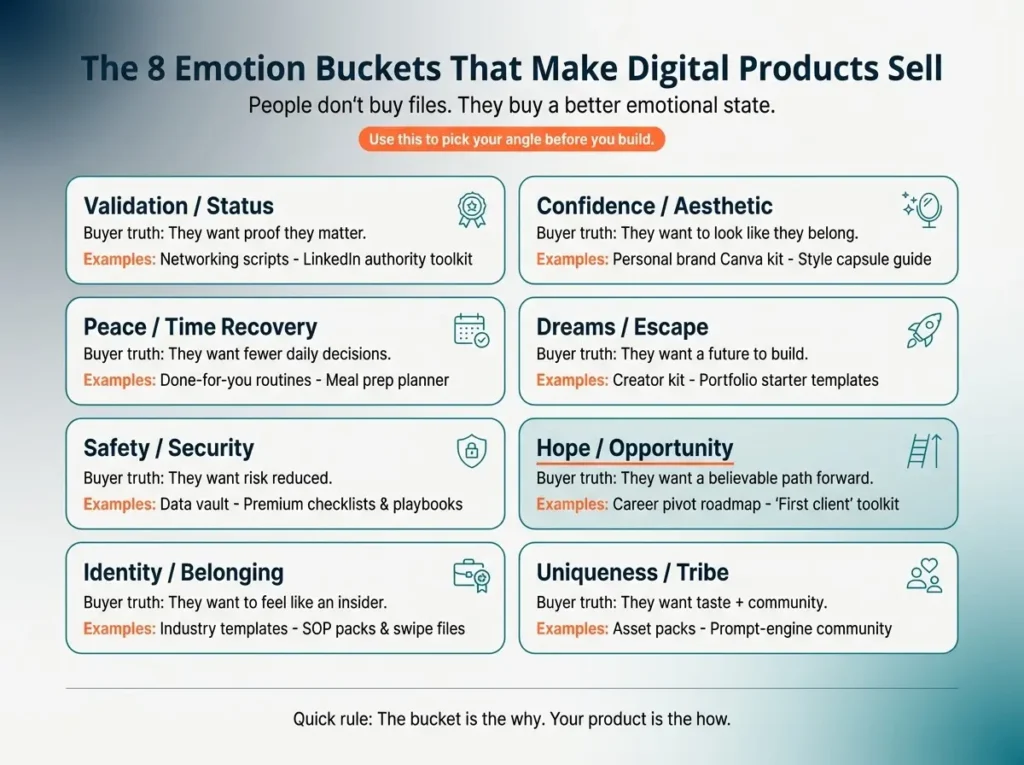
The 8 Emotion Buckets That Make Digital Products Sell
If you want to learn how to use emotions to create and sell profitable digital products, stop hunting for “winning ideas” and start spotting emotional patterns. Most digital products people actually buy fit into a small set of repeatable emotional needs—because humans change more slowly than tech.
Here’s the psychology-product matrix (use it to choose your angle before you choose your format).
| Target audience | Core emotional need | What they’re really buying | Digital product examples (evergreen) |
|---|---|---|---|
| Men | Validation / status | Proof they matter | Networking scripts, LinkedIn authority toolkit, confidence interview answers pack. |
| Women | Confidence / aesthetic | Visual proof they belong | Personal brand Canva kit, style capsule guide, “glow-up” routine system |
| Parents | Peace / time recovery | Fewer daily decisions | Done-for-you family systems, meal prep planner, routines dashboard |
| Youth / students | Dreams / escape | Tools to build identity | Creator kits, hook libraries, portfolio starter templates |
| High-income buyers | Safety / status | Risk reduction + signal | Private mastermind, data vault, premium playbooks, and checklists |
| Low-income / starting out | Hope / opportunity | A believable path forward | Career pivot roadmap, “first client” toolkit, starter courses |
| Professionals | Identity / belonging | Shortcut to looking like an insider | Industry templates, SOP packs, swipe files, Notion dashboards |
| Creatives | Uniqueness / tribe | Taste + community | Asset packs, prompt-engine communities, creative challenges |
A quick rule that keeps you honest: the “bucket” is the why; your product is the how. When you nail the why, you can sell the same underlying asset three different ways just by changing the emotional promise—this is the core of emotion-driven digital products.
Most creators don’t have a “marketing problem.” They have a “wrong emotion” problem. If the buyer doesn’t feel the payoff in the headline, they will not care how beautiful your PDF is.
Match the Format to the Feeling (Templates, Toolkits, Courses, Memberships)
Once you pick the emotional bucket, your format should make that emotion arrive faster. A mismatch here kills conversions because you’re forcing people to work too hard to get the feeling they came for.
1. Templates & calculators (for peace and utility)
Templates win when the buyer is overwhelmed and wants relief now.
This is where template business ideas thrive: planners, dashboards, checklists, calculators, “plug-and-play” scripts—anything that reduces decisions.
2. Toolkits & AI prompt packs (for validation and status)
Toolkits work when the buyer wants to look competent fast. AI prompt packs and swipe files sell well here because they feel like an “insider shortcut,” not homework.
3. Courses & membership communities (for hope and tribe)
Courses win when the buyer needs a path, not a patch. Memberships win when the buyer needs belief, momentum, and people. This is why membership to communities often outperforms one-off downloads over time.
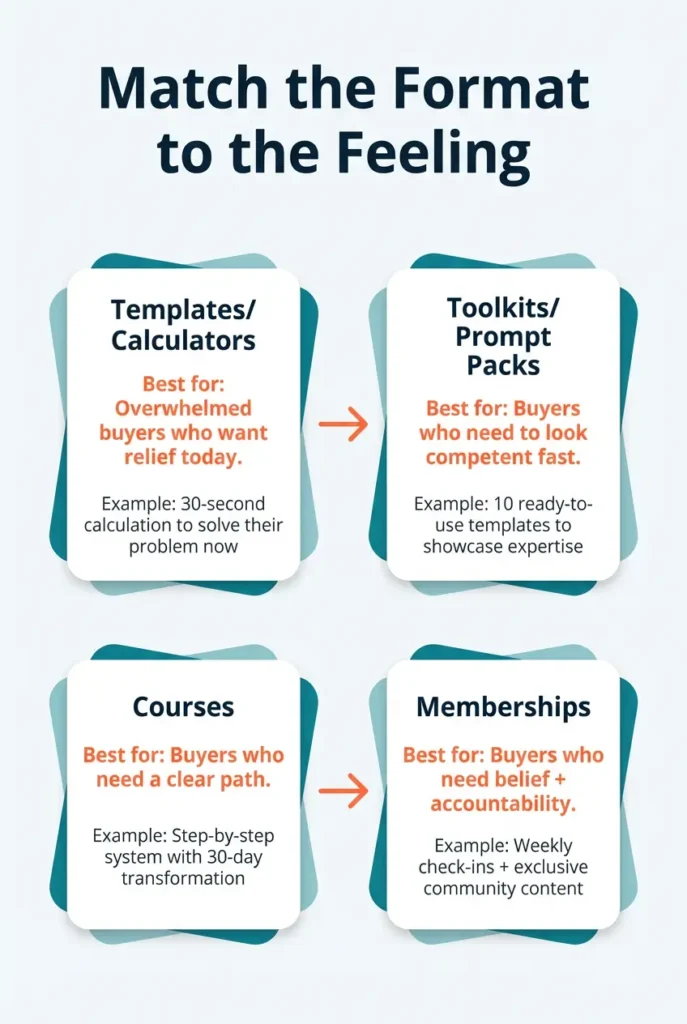
Practical shortcut: if your buyer is tired, sell a template; if they’re insecure, sell a toolkit; if they’re stuck, sell a program; if they’re alone, sell a community.
People Also Read: Realistic Ways to Turn AI Prompts into Income: A Comprehensive Guide
Validate Before You Build (60-Minute Digital Product Validation Method)
Most creators waste weeks building “perfect” products for imaginary customers. The smarter move is to validate the emotion first, then build the smallest version that delivers it.
This is the simplest of the digital product validation methods I use (fast, cheap, and ethical).
Step 1: Pain-point audit (20 minutes)
Go where people complain: Reddit threads, Quora questions, YouTube comments, competitor reviews. You’re looking for phrases like “I wish there was a way to…,” “Why is this so hard?,” or “I would pay someone to do this.”
Step 2: Smoke test (30 minutes)
Write a tiny landing page or post that sells the outcome, not the file.
- Bad: “I’m making a PDF about gardening.”
- Good: “I’m building a 5-square-foot system to help apartment renters grow weekly salads, without killing plants.”
Step 3: Pre-sell (10 minutes)
Offer a “founding member” price and ask for payment before it’s built. If 5–10 people pay, you’ve got real demand; if nobody pays, you just saved yourself months.
This is also the fastest way to discover niche digital product ideas that aren’t obvious from generic keyword tools—because you’re pulling them straight from real frustration.
Where to Find Proof Signals (So You’re Not Guessing)
When you’re selling a feeling, you still need proof that the feeling is in demand.
- Reddit/Quora pain mining: find repeated “how do I…” and “I’m so frustrated with…” posts.
- Search autocomplete: type “[niche] template / toolkit / prompts” and see what Google suggests.
- 1-star reviews: customers will literally tell you what to build when they say, “I wish this had…”
These proof signals do something magical: they hand you the exact words buyers use. These are words you can mirror in your headline and subheads for stronger CTR and relevance.
Pricing Your Digital Products with Psychology (Good / Better / Best)
Pricing is not math. Pricing is emotion. People pay more when the outcome feels certain, fast, and socially safe.
Here’s the clean structure that matches how people buy:
- Good ($): The Hope Tier — Low-risk entry ($7-$17)
This catches people who are interested but scared. They’re testing you. Make this tier irresistible and overdeliver. These buyers become your best testimonials. - Better ($$): The Solution Tier — Core transformation ($27-$127)
This is where most revenue lives. It’s the “real” product. Price it for the emotional outcome value, not your creation time. - Best ($$$): The Status Tier — Done-for-you or exclusive access ($297-$997+)
This is for buyers who value time over money, or who want the “VIP” signal. Even if only 5-8% buy this tier, it can represent 30-40% of total revenue.
A grounded take: low prices don’t always increase sales; sometimes they reduce trust. If you’re using emotional marketing strategies ethically, the price should reflect the value of relief and identity change, not the number of pages in your PDF.
People Also Read: How to Make Money with AI: The Ultimate & Proven Beginner’s Guide
Conclusion: Sell Feelings, Not Files
Here’s what I’ve learned from 40+ product launches and a six-figure digital product revenue: the easiest products to create are often the hardest to sell. Generic PDFs, broad courses, and “everything you need to know” guides get ignored. The products that sell best are usually hyper-specific and emotion-first, because they promise a concrete transformation.
The real unlock is this: once you understand the 8 emotion buckets, creating “hard” digital products becomes a repeatable formula. Pick one audience, list their top three frustrations this week, and choose the one you’d happily pay to make disappear.
Build that outcome, validate fast, and ship.
Frequently Asked Questions About Using Emotions for Digital Products
What does “sell feelings, not files” mean for digital products?
It means customers buy emotional outcomes like confidence, relief, status, not the PDF itself. Emotional selling works because people purchase based on how a product makes them feel and what it enables them to become.
How to use emotions to create and sell profitable digital products?
Start with the desired feeling (peace, confidence, status), then design a product that delivers it fast: templates for relief, toolkits/prompt packs for speed, memberships for belonging. Write the headline as the emotional end state, not the format.
What’s the fastest way to validate a digital product idea?
Run a smoke test: publish a landing page or offer for something not built yet, measure sign-ups/clicks, then pre-sell a “founding” version to confirm real demand before investing time.
Is emotional marketing ethical when selling digital products?
Yes. When the product genuinely delivers the promised outcome and doesn’t manipulate or mislead. Emotional marketing is an approach to influence decisions by connecting to real needs; it becomes unethical when it overpromises and underdelivers.