
OpenAI Future AI Strategy: Future-Proof Your AI Prompt Strategy & Side Hustles
If you have been watching the headlines lately, you know things are shifting at the top. The OpenAI future AI strategy is no longer just about building a smarter chatbot; it is about reshaping how the entire world does business. With their latest strategic hire—a move that screams “scale” and “governance” rather than just “research”—the writing is on the wall.
I remember when GPT-3 first dropped. Everyone was scrambling just to get access. Now, the game isn’t about access anymore; it’s about integration. If you are still trying to sell simple prompt packs for $5 on Etsy, I have some tough love for you: that ship is sailing fast. But don’t panic. A much bigger, more luxurious yacht is pulling into the harbor, and I want you on it.
This new leadership addition signals that OpenAI is aggressively moving toward enterprise domination and sophisticated ecosystem building. What does that mean for you? It means the OpenAI future AI strategy is prioritizing reliability, safety, and complex workflows over mere creativity. For the savvy hustler, this is where the real money is hiding.
Key Takeaways
- OpenAI’s new strategic direction shifts value from basic prompt writing to complex system integration and workflow automation.
- The most profitable future AI side hustles will focus on corporate training, compliance, and maintaining custom GPT infrastructures.
- Freelancers must pivot from selling single deliverables to building ‘Content Engines’ and automated systems to survive the next AI wave.
- Contextual Engineering is replacing traditional Prompt Engineering, requiring deeper knowledge of structured data and multi-turn workflows.
- Monetizing AI skills now requires understanding enterprise needs and policy compliance rather than just generating creative text.
Decoding the Signal: Where is OpenAI Heading Next?
Let’s play detective for a moment. When a company like OpenAI hires a heavyweight with a background in global policy or massive consumer product scaling, they aren’t doing it to make ChatGPT tell better jokes. They are doing it to make their AI the backbone of the global economy. This is a critical pivot in the OpenAI future AI strategy.
For years, we treated OpenAI like a research lab. We were beta testers playing with magic toys. Now, they are transitioning into a “ubiquitous utility”—think electricity or the internet itself. They want their models running invisibly inside every piece of software you use, from Excel to your refrigerator.
The “System Instruction” Shift
Here is my hot take: The days of “magic spell” prompting are numbered. You know the ones—”Act as a world-class copywriter and write me a viral tweet.” While useful, these are becoming commodity features built into software.
I’ve noticed a clear trend in the API updates over the last six months. The models are getting better at following complex, multi-step instructions without needing to be coaxed. The OpenAI next move seems to be reducing the friction of prompting so that average users get great results without needing a “prompt engineer.”
This means your value isn’t in knowing what to ask the AI anymore. Your value is in knowing how to weave that AI into a business process that saves time or makes money. We are moving from “Generators” to “Operators.”
The Decline of Basic Prompting: Evolving Your Skills
If your entire business model relies on typing “Write a blog post about dog food,” you are in trouble. Models are getting so smart that they can infer intent. Basic prompting is becoming obsolete because the “base level” competence of the AI is rising.
So, what replaces it? Welcome to the era of Contextual Engineering.
Contextual Engineering isn’t about the perfect sentence; it’s about feeding the AI the perfect data diet. It’s about understanding that the output is only as good as the context you provide.
I recently tried to generate a sales landing page using a generic prompt versus a “contextually engineered” one. The generic one was fine—it sounded like every other marketing fluff piece. The engineered one? It used specific customer pain points, competitor analysis, and brand voice guidelines I fed it beforehand. It converted at 4.5% compared to the generic 1.2%.
To stay ahead of prompt engineering trends, you need to think in workflows, not chat boxes.
The Skill Gap: Old Way vs. New Way
Take a look at this comparison. This is where you need to move your mindset.
| The Old Way (One-Shot Prompting) | The New Way (Contextual Engineering) |
|---|---|
| “Write a 500-word article about SEO.” | “Analyze these 3 top-ranking URLs, extract the H2 structures, and draft a content brief that fills the gaps they missed.” |
| Focus on creative phrasing and “hacks.” | Focus on structured data inputs (JSON, CSV) and logic. |
| Single interaction (Ask -> Get). | Multi-turn workflows (Ask -> Refine -> Critique -> Finalize). |
| Outcome: Generic text. | Outcome: A strategic asset tailored to a specific goal. |
The future of AI prompts relies on structure. The models love structure. If you can speak their language—JSON, markdown tables, step-by-step reasoning chains—you will win.
Related Reading: The Best Way to Write AI Prompts That Provide High Value (And Save You Hours)
New AI Side Hustles Emerging from This Strategic Shift
I know you are here to figure out how to monetize AI skills in this new landscape. The basic “I’ll write your tweets” gigs are drying up because business owners can do that themselves now. But new, higher-paying gaps are opening up.
Here are three AI side hustles I am seeing explode right now.
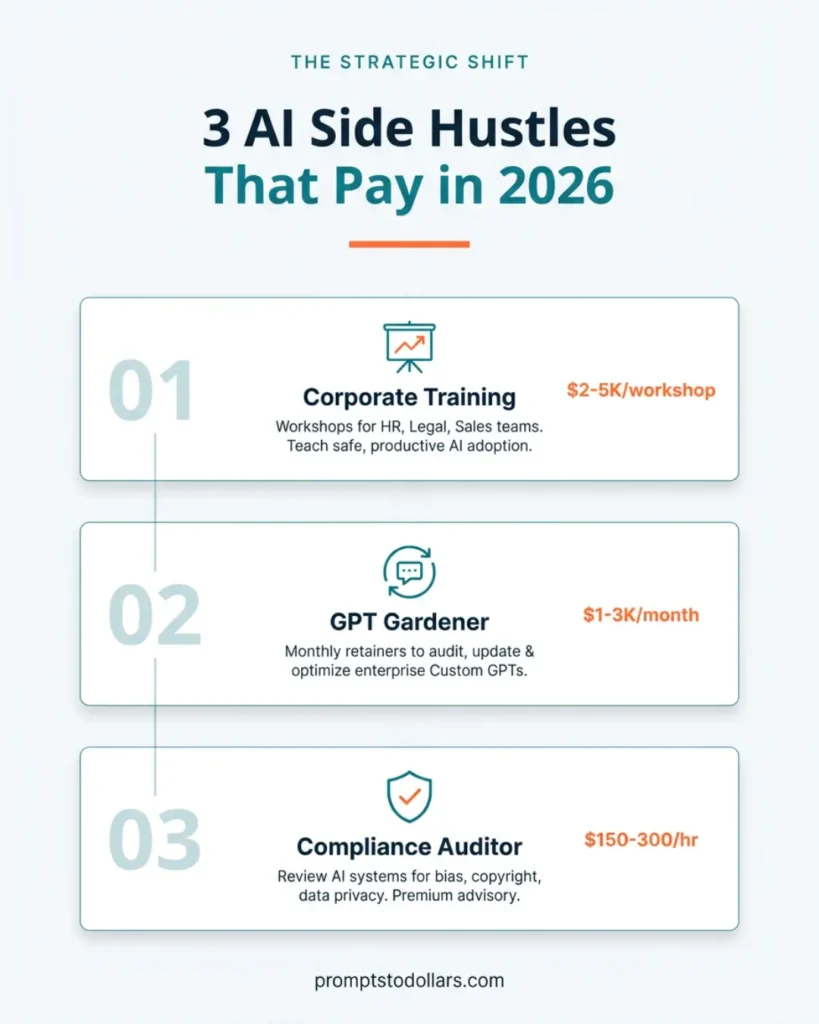
1. Corporate AI Training & Workflow Design
As the OpenAI future AI strategy targets the enterprise, big companies are panicking. They bought the enterprise licenses, but their employees have no clue how to use them safely or effectively. They don’t need a prompt library; they need a human to come in and say, “Here is how you use ChatGPT to cut your reporting time by 50%.”
The Opportunity: specialized workshops. “AI for HR Professionals” or “AI for Real Estate Agents.” You aren’t teaching them to write poetry; you are teaching them productivity.
2. Custom GPT Maintenance & Optimization
Building a custom GPT is easy. Keeping it useful is hard. I have a client who built a “Customer Support GPT.” It was great for a week until their pricing changed. They forgot to update the knowledge base, and the AI started lying to customers. Disaster.
The Opportunity: The “GPT Gardener.” You charge a monthly retainer to audit, update, and refine a company’s internal AI tools. You ensure the knowledge files are current and the instructions are tweaked based on user feedback. It’s the new website maintenance.
3. AI Ethics & Compliance Auditing
With the new hire likely focusing on policy, compliance is becoming a massive niche. Companies are terrified of their AI hallucinating or leaking data. If you can learn the basics of AI safety and data privacy (not as hard as it sounds), you can offer auditing services.
The Opportunity: Reviewing a company’s prompt libraries and custom bots to ensure they aren’t violating copyright or biased against certain groups. This is a premium service.
Read this article to discover more services you can offer by leveraging AI
Actionable Playbook: 3 Prompts to Future-Proof Your Workflow
To align with the OpenAI future AI strategy, you need prompts that leverage reasoning and data synthesis. These aren’t just questions; they are mini-programs.
Here are 8 copy-paste prompts designed for 2026 and beyond.
Prompt Set 1: The Strategic Forecaster
This uses the AI’s reasoning capabilities to simulate future scenarios. Great for business planning.
Copy-paste prompt
My Business Context: [Insert 2-3 sentences about what you do].
Task:
1. Identify 3 specific ‘Failure Scenarios’ that could happen in the next 12 months due to market shifts.
2. For each scenario, provide a ‘Prevention Protocol’—a concrete action I can take today to mitigate that risk.
3. Rate the probability of each scenario (Low/Med/High) based on general industry patterns.
Output format: A markdown table.
Prompt Set 2: The Recursive Improver (Self-Healing Prompt)
This is my favorite. It asks the AI to critique its own work before showing it to you. This mimics the “Chain of Thought” reasoning that newer models excel at.
Copy-paste prompt
Constraints:
– Tone: [Tone]
– Goal: [Goal]
Process:
1. Draft Version 1 internally (do not show me yet).
2. Critique Version 1 against the constraints. Identify 3 weaknesses.
3. Draft Version 2 incorporating those fixes.
4. Critique Version 2. Identify remaining fluff or generic language.
5. Output ONLY Version 3 (the final polished version) and a bulleted list of ‘Why this works better’.
Prompt Set 3: The Data Synthesis Engine
The future of AI prompts is about handling messy data. Use this when a client dumps a pile of unstructured notes on you.
Copy-paste prompt
[Paste Transcript Here]
Task:
1. Extract all action items and assign a hypothetical owner (Client or Agency).
2. Identify any deadlines mentioned (explicit or implied).
3. Summarize the key project constraints.
4. Format the output as a JSON object that I can import into a project management tool. Keys should be: ‘Task_Name’, ‘Owner’, ‘Due_Date’, ‘Priority’.
Bonus: Quick-Fire Productivity Prompts
Here are a few shorter ones to keep in your back pocket for AI productivity tools integration.
- The Devil’s Advocate: “I am about to make this decision: [Insert Decision]. Roast this decision. Tell me exactly why it is a terrible idea and what logical fallacies I might be falling for.”
- The Analogy Maker: “Explain the concept of [Complex Technical Topic] to a [Specific Audience, e.g., 50-year-old CEO] using an analogy related to [Audience’s Hobby, e.g., Golf].”
- The Style Thief: “Analyze the writing style of the text below. Describe the tone, sentence structure, and vocabulary complexity. Then, rewrite the following paragraph to match that exact style. Text to analyze: [Paste Text].”
- The API Formatter: “Convert the following list of FAQs into Schema.org compliant JSON-LD markup for an FAQPage.”
- The Negotiation Simulator: “I need to negotiate a higher rate with a client. Simulate a roleplay. You are the skeptical client who thinks my rates are too high. I will start. Respond naturally, but be tough.”
Adapting Your Freelance Offer: From ‘Content’ to ‘Systems’
This is the most important section for your wallet. If you are freelancing, you need to stop selling “things” and start selling “machines.”
I used to sell blog posts for $100. It was a grind. I was competing with thousands of other writers, and eventually, I was competing with the clients using ChatGPT themselves. So, I pivoted. I started selling “Content Engines.”
Mini Case Study: The $1,000 System Setup
I had a client who wanted 10 articles. Instead of just writing them, I pitched her this:
She took the system. Why? because AI freelancing opportunities are moving toward empowerment. She didn’t want to be dependent on me forever. She wanted the capability.
I spent 3 hours setting up the system. Writing the articles manually would have taken me 20 hours.
To succeed with the OpenAI future AI strategy, you must package OpenAI’s tools into a cohesive system. Don’t just give them a fish; build them a high-tech fishing trawler.
MUST READ: Make Money with AI: Ultimate Beginner Guide
The Verdict: Is the Gold Rush Over or Just Beginning?
So, looking at the OpenAI future AI strategy and their heavyweight hiring choices, is the party over? Absolutely not.
The “easy money” era of low-effort AI arbitrage—where you could copy-paste a prompt and sell the result—is dead and buried. Good riddance. It was cluttering the market anyway.
But the “smart money” era? The era of integration, strategy, and systems? It is just getting started. We are in the first inning of the enterprise adoption phase. The businesses that are going to win in the next five years are the ones that figure out how to weave AI into their DNA. They need guides. They need builders. They need you.
Frequently Asked Questions (FAQs)
Will OpenAI’s new strategy make prompt engineers obsolete?
Not obsolete, but the role is evolving. “Prompting” is becoming a baseline skill like typing. The new high-value role is “AI Systems Architect”—someone who connects prompts, data, and workflows to solve business problems.
What is the best way to start an AI side hustle in 2026?
Focus on “Service as a Software” (SaaS) or specialized training. Don’t just generate content; build a Custom GPT that solves a specific niche problem (e.g., “Grant Writing Assistant for Non-Profits”) and sell access or consulting around it.
How can I stay updated on OpenAI’s next move?
Ignore the hype on Twitter/X. Read the official OpenAI research papers and API changelogs. That is where the real signal is. When they change the API capabilities, they are telling you what the future business model looks like.
Is it too late to learn AI skills?
No! We are still early. Most companies are still using AI like a glorified search engine. If you learn how to use it for data analysis, coding assistance, or automation, you are instantly in the top 1% of the workforce.