
Before You Use AI for Freelance Writing, You MUST Do This: The 2026 Survival Protocol
Before I use AI for freelance writing, I lock in five non-negotiables, I lock in five non-negotiables: blank-page thinking, a documented voice baseline, a public usage policy, a human-in-the-loop verification workflow, and contract clauses that protect both my clients and my work.
Without these foundations, AI doesn’t amplify my value. It simply exposes that I never had a defensible process to begin with.
I’ve watched the “middle class” of freelance writing collapse over the last 2 years. Writers I knew who earned solid rates are now competing for $0.02-per-word commodity work or pivoting entirely out of the industry.
The market has split into two brutal camps: low-end “AI slop” that anyone with ChatGPT can produce, and high-value “agentic writing” where writers orchestrate AI without outsourcing their thinking.
I refuse to be commoditized as an intern for a language model. So I built a survival protocol that governs how I use AI for freelance writing. This set of guardrails protects my value while maximizing efficiency.
Key Takeaways
- Master manual writing first: Before you use AI for freelance writing, draft without it so you keep your thinking “taste” and avoid generic output.
- Build a voice baseline: Turn your best writing samples into a style blueprint, so AI sounds like you, not like everyone else.
- Be transparent on purpose: Publish an AI usage policy for clients and readers to build trust and stay aligned with tightening disclosure expectations.
- Verify everything, every time: Tag AI drafts as “do not publish,” then fact-check claims against primary sources and remove obvious AI tells.
- Sell outcomes, not words: Move from cheap per-word work to outcome-based packages backed by protective contract clauses.
The End of “Good Enough”: Why 2026 Is the Great Decoupling
2026 marks what I call the “Great Decoupling,” that is, the point where writers stop selling words and start selling outcomes. Clients no longer care if you typed 2,000 words or orchestrated an AI to draft them. They care whether the piece drives conversions, ranks for their target keywords, or positions them as authorities in their niche.
The uncomfortable truth? AI has made execution almost free. What separates a $50 blog post from a $500 article isn’t the time it takes to produce. It is the strategy, research depth, verification rigor, and distinctive voice that went into it.
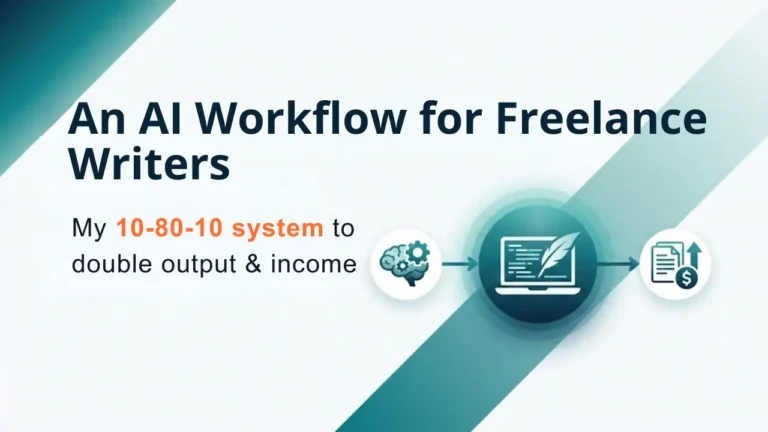
Agentic Writing is my framework for this new reality. It means I own the strategy, govern the AI’s execution, and verify every output before it ships. The AI handles the grunt work, such as expanding outlines, generating variations, and polishing syntax. I handle the thinking.
Most writers get this backward. They let AI think for them, then spend hours editing mediocre output that sounds like every other AI-generated piece on the internet. That’s not leverage. That’s just outsourcing your value proposition to a tool everyone else has access to.
This is the future of freelance writing with AI: writers who govern the technology instead of being governed by it.
>> To understand more about using AI in freelancing, read this article: A Guide for Freelancing with AI in 2026 and Beyond
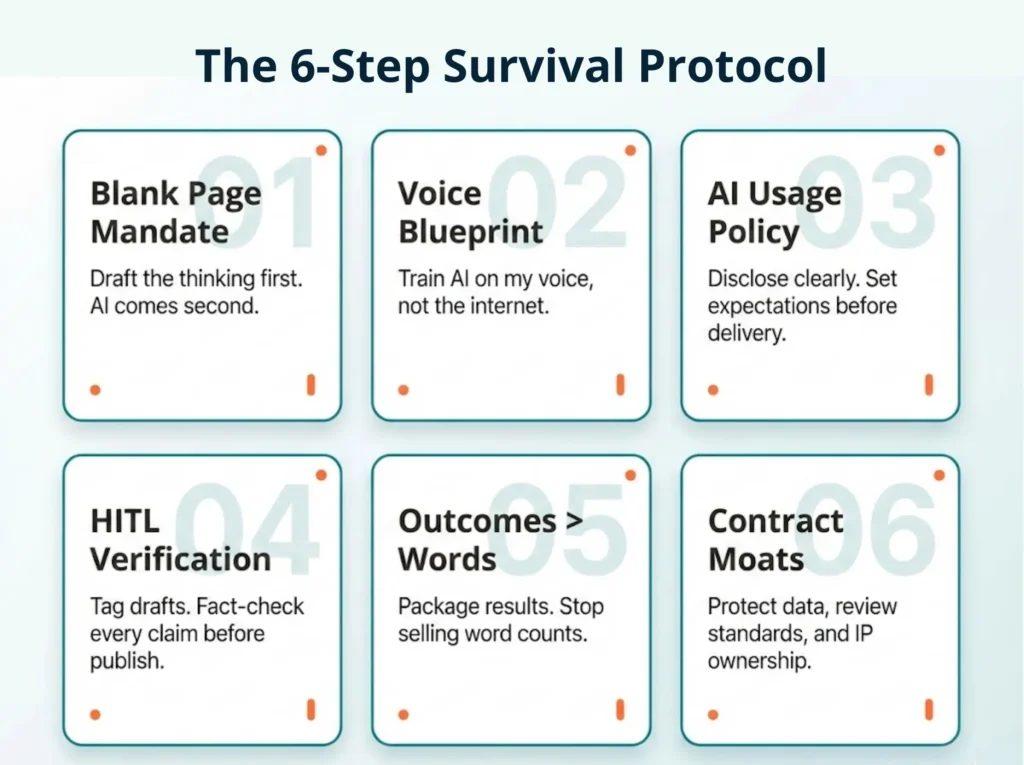
Step 1: The Blank Page Mandate (My Non-Negotiable Rule)
I do not let AI write my first draft.
This isn’t about being a purist or romanticizing struggle. It’s about protecting the one skill that AI can’t replicate: original thinking under constraints. When I outsource the drafting phase too early, I atrophy my ability to wrestle with complex problems, make logical connections, and develop the “taste” that differentiates good work from average work.
Here’s what I mean by “taste”: knowing when a sentence feels off, recognizing when an argument needs more support, and sensing when a transition is clunky. AI doesn’t have taste. Instead, it has statistical patterns trained on billions of mediocre internet documents. If I rely on it to think through my ideas, I end up with output that’s technically correct but strategically hollow.
My Blank-Page Checklist:
- Draft the ugly outline manually (thesis, 3–5 key arguments, objections I need to address)
- Write the most controversial or complex section first to prove I understand the topic
- Note examples, data points, or quotes I can defend in a client call
- Only then use AI to expand, reorganize, or sharpen what I’ve already thought through
- Never delegate the “what should I say?” decision to the model
Last month, I skipped this step on a technical B2B piece about compliance software. I fed ChatGPT a vague prompt and let it generate the structure. The output was polished, professional, and completely generic—it could’ve been about any compliance tool. I had to scrap 70% of it and start over with my own research and angle. That mistake cost me four hours I’ll never get back.
Now I struggle with the blank page first. It’s uncomfortable, but it’s the only way I stay valuable in a market where everyone has access to the same AI tools.
Related Reading: The Blueprint for Easy AI Side Hustle 2026: Building Digital Products for Passive Income
Step 2: Build a Voice Baseline AI Can’t Fake
When you use AI for freelance writing without a voice baseline, the output sounds generic…like AI.
Overuse of transition phrases like “Moreover” and “Furthermore.” Clichés like “game-changer,” “robust,” and “it’s important to note.” These patterns scream “low-effort automation” to both human readers and Google’s quality algorithms.
My solution? I built a Voice Blueprint. This documented style guide is trained on my actual writing, so the AI mirrors my patterns rather than generic internet text.
How I Built My Voice Blueprint:
- Compiled 5–10 of my best manual writing samples (portfolio pieces, popular blog posts, client work I’m proud of)
- Analyzed them for sentence length variability, vocabulary preferences, formatting quirks, and tonal boundaries
- Created a “ban list” of AI-isms I never use (delve, leverage as a verb, paradigm shift, etc.)
- Fed this baseline into Gemini Gem as a custom project with explicit style rules
For example, my style rules include: “Vary sentence length aggressively by mixing 5-word punches with 25-word explanations. Never use ‘delve’ or ‘dive deep.’ Prefer active verbs over adjectives. Break grammar rules for emphasis when it serves clarity.”
The result? When I prompt “Write this section using my voice blueprint,” in Gemin Gems or ChatGPT Projects, the output sounds like me rather than a Wikipedia article processed through a thesaurus.
Voice Blueprint Template:
- Sentence length range: [e.g., 8–30 words, with occasional 5-word fragments for emphasis]
- Forbidden words/phrases: [your AI-ism ban list]
- Punctuation preferences: [e.g., em-dashes for asides, minimal semicolons, Oxford comma always]
- Tone boundaries: [e.g., conversational but not casual, confident without hype]
- Formatting quirks: [e.g., bold for key terms, bullet lists over long paragraphs]
AI Prompt Template Sample for Generating your Voice Blueprint:
CONTEXT:
I’m a freelance writer building an AI voice baseline. I need you to analyze my writing samples and create a comprehensive style guide that captures my authentic voice patterns.
SAMPLES TO ANALYZE:
The pasted text below OR the attached files.
[Paste of upload 3-5 of your best writing samples here, totaling 2,000-5,000 words. Include portfolio pieces, blog posts, or client work that represents your strongest voice.]
YOUR TASK:
Analyze these samples and create a detailed Voice Blueprint document with the following sections:
1. SENTENCE ARCHITECTURE
– Average sentence length range
– Sentence variety patterns (simple vs. complex ratio)
– Punctuation signature (em-dashes, semicolons, fragments, etc.)
– Paragraph length preferences
2. VOCABULARY PROFILE
– Frequently used power words and phrases
– Industry-specific terminology I favor
– Conversational markers (contractions, colloquialisms)
– Words/phrases I NEVER use (create a ban-list)
3. TONAL BOUNDARIES
– Level of formality (scale 1-10)
– Use of humor, sarcasm, or wit
– Degree of assertiveness vs. hedging
– Emotional range (analytical, empathetic, provocative, etc.)
4. STRUCTURAL PATTERNS
– How I open articles (hooks, questions, stories, data)
– Transition techniques between ideas
– Use of lists vs. paragraphs
– How do I conclude sections
5. AI-ISM DETECTION
– List 10-20 phrases commonly found in AI writing that do NOT appear in my samples
– Identify clichés I avoid
– Note any grammar “rules” I intentionally break
6. STYLE RULES (Create 8-10 concrete rules)
Example format: “Always vary sentence length—mix 8-word punches with 25-word explanations”
OUTPUT FORMAT:
Present this as a copy/paste style guide I can feed into future AI sessions.
CONSTRAINT:
Base your analysis ONLY on patterns present in my actual samples. Do not invent preferences or default to generic writing advice.
NOTE: Save the AI’s output as “My_Voice_Blueprint.txt” and paste it into the custom instructions section of ChatGPT or as a Claude Project document. Reference it in every content generation prompt.
MUST Read: The Blueprint for Easy AI Side Hustle 2026: Building Digital Products for Passive Income
Step 3: Set My AI Usage Policy (And Publish It)
When you use AI in freelance writing, transparency isn’t optional anymore. It is a legal and competitive requirement.
The EU is enforcing transparency and labeling obligations for AI-generated content, with major compliance deadlines targeting mid-2026. Even if you’re not in Europe, clients increasingly expect clarity about how you use automation in their deliverables.
I don’t hide my use of AI. I codify it in a public policy that lives on my website and gets attached to every client contract.
My AI Usage Policy (The Short Version)
Here’s the framework I follow when I use AI for freelance writing:
- AI’s role: I use AI for drafting, expanding outlines, generating variations, and polishing syntax, but I never use it for original strategy or thinking.
- What AI can’t do: Make strategic decisions, conduct primary research, verify facts, or replace my editorial judgment.
- Human review guarantee: Every deliverable undergoes rigorous human editing, fact-checking, and style refinement before delivery.
- Client data protection: I never use proprietary client information to train general-purpose AI models.
- Disclosure standard: If a client or audience asks, I’ll explain exactly how AI was used in the workflow.
This policy does two things.
- First, it sets expectations because clients know they’re hiring me for strategy and judgment, not just execution speed.
- Second, it protects me from scope creep or disputes about “AI-generated content” quality issues.
Pro tip: Frame your policy as a quality control measure, not a confession. I tell clients, “I use AI the same way a designer uses Photoshop, as a tool that speeds up execution while I control the creative direction.”
Step 4: Adopt Human-in-the-Loop Verification (Kill Hallucinations)
AI hallucinates. It invents citations, fabricates statistics, and confidently states false information as fact.
If you submit or publish that unverified output, you are legally and professionally liable for the misinformation. This liability does not fall on OpenAI, Anthropic, or the model.
Therefore, you should treat every AI draft as a dangerous first pass that requires surgical fact-checking before it goes live or is delivered to the client.
My HITL (Human-in-the-Loop) Workflow:
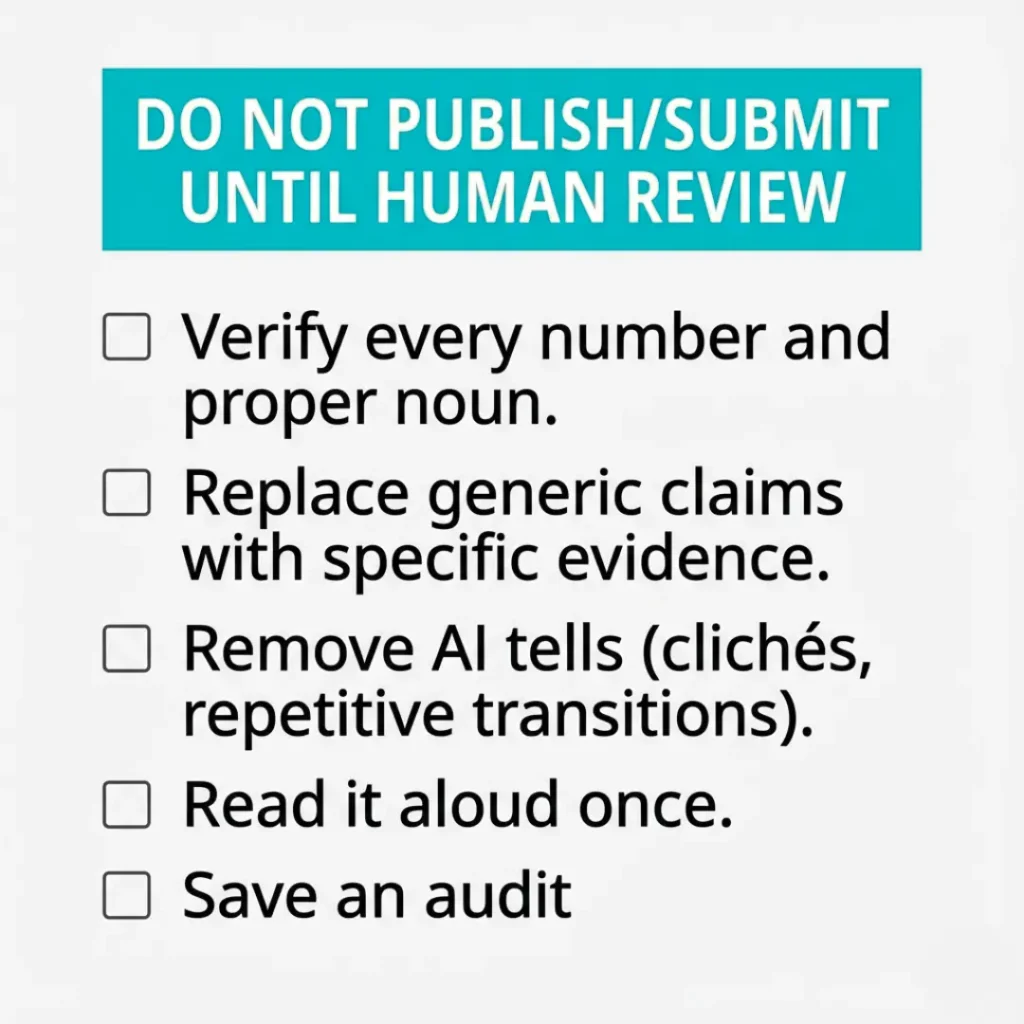
- Tag the draft: I paste this on my AI agents at the top of every AI-generated text: “
⚠️ DO NOT PUBLISH UNTIL HUMAN REVIEW ⚠️” - Fact-check every claim: I cross-reference statistics, definitions, and examples against primary sources (company websites, official reports, and reputable websites like BBC, NYT). Never trust Wikipedia or the AI’s memory.
- Strip AI tells: I manually remove robotic patterns like repetitive em-dashes, “soulless” perfect grammar, and phrases like “Moreover” starting three consecutive paragraphs.
- Create an audit trail: For high-stakes clients (legal, medical, financial), I maintain version history or screen recordings as “Proof of Human Labor” if my work is ever challenged.
This process takes 10–15 minutes per 1,000 words. It’s not optional.
My 10-Minute Verification Routine:
- Scan for numbers or percentages → verify against original source.
- Check proper nouns (company names, product names, people) → confirm spelling and context.
- Google any claim that sounds too convenient or suspiciously specific.
- Read the piece aloud to catch awkward phrasing AI loves, but humans don’t say.
- Run a final “smell test”: Would I defend this piece in a client call without hedging?
Last week, ChatGPT told me that “73% of B2B buyers prefer video content over written testimonials.” That sounded plausible, so I almost kept it. Then I fact-checked—turns out the real stat is 53% (according to Zebracart), and it’s from a 2025 report, not 2023. That 14-point error would’ve tanked my credibility with a data-savvy client.
The rule: I don’t publish AI-written facts unless I can personally verify them. Period.
People Also Read: Profitable Fiverr Gig Ideas: Humanize AI Content, Get Paid
Step 5: Reposition from Words to Outcomes (The Business Pivot)
The pay-per-word model is effectively dead for AI-assisted work.
Here’s why: if you use AI to write 3x faster but still bill hourly, you are punishing your own efficiency. Clients get faster delivery, but you earn less per project. That’s a race to the bottom.
The market has already corrected. Low-end SEO content and product descriptions have seen rates collapse by 50–75% due to AI saturation. Standard AI-assisted blog posts now price around $0.01–$0.03 per word, which is roughly half of pre-AI human rates.
But here’s the flip side: high-domain agentic experts who orchestrate AI for complex deliverables command $75–$200+ per hour.
The difference? They’re not selling typing speed. They’re selling strategy, risk reduction, and measurable content outcomes.
What to Sell Instead of Words:
- Content strategy: Keyword research, competitor gap analysis, audience journey mapping.
- Subject matter access: Interviews with internal experts, proprietary data interpretation
- Risk mitigation: Legal/compliance review, fact-checking for regulated industries
- Performance optimization: A/B testing insights, conversion rate improvements, SEO ranking tracking
Package these as outcome-based deliverables, not word counts. A client doesn’t pay you for “2,000 words.” They pay for “a pillar article that ranks in the top 5 for [target keyword] within 90 days and generates 5000+ monthly organic visits.”
Pricing Reality Check (2026 Market):
| Work Type | Rate Range | What Clients Buy |
| Commodity AI content | $0.01–$0.03/word | Bulk blog posts, product descriptions |
| AI-assisted generalist | $0.05–$0.10/word | Standard articles with light editing |
| Agentic specialist | $75–$200/hour | Strategy, interviews, verification, outcomes |
Top-tier freelance writers I have interacted with claim they stopped accepting per-word projects in Q4 2025. Their rates tripled when they repositioned themselves as “a content strategist who uses AI” rather than “a writer who types fast.”
Read Also: 15 NotebookLM AI Fiverr Gig Ideas: Easy Services to Sell
Step 6: Protect My Work with Contract Clauses (Contractual Moats)
Standard freelance contracts weren’t written for the AI era. They don’t address who owns AI-assisted work, whether clients can use my outputs to train their own models, or how to prove “human creative input” for copyright purposes.
You should never sign a contract or send a proposal without three mandatory clauses.
1. No-AI Training Clause
This explicitly forbids the client from using my deliverables or any proprietary information I access during the project to train general-purpose AI models. It protects both their competitive data and my creative process from being scraped into someone else’s LLM.
Sample language: “Freelancer’s deliverables and any client proprietary information provided during this engagement shall not be used to train, fine-tune, or improve artificial intelligence models, whether internal or third-party, without prior written consent.”
2. Human Review Mandate
This contractually guarantees that all AI-generated outputs have undergone rigorous human editing, fact-checking, and quality control before delivery. It shifts liability away from “the AI made a mistake” and establishes that I take professional responsibility for accuracy.
Sample language: “All deliverables, regardless of tools or technologies used in their creation, are subject to comprehensive human review, including fact verification, editorial refinement, and alignment with Client’s brand standards before final submission.”
3. IP Ownership Definition (Human-Directed Work)
Current U.S. copyright law doesn’t protect purely AI-generated content since it requires “sufficient human creative input.” This clause frames my deliverables as human-created or human-directed to ensure they’re eligible for copyright protection and can be transferred to the client.
Sample language: “Deliverables are created through a human-directed creative process in which Freelancer provides original strategy, research, editorial judgment, and final approval. Any AI tools used serve as assistive technologies under Freelancer’s direct supervision and control.”
These clauses have saved me twice from scope disputes. In one case, a SaaS client asked if they could feed my articles into their internal knowledge base LLM. Because I had the no-training clause, I was able to negotiate a separate licensing fee for that use. Without it, I’d have given away IP rights I didn’t even know were on the table.
Conclusion: From Commoditized to Irreplaceable
This protocol isn’t about fearing AI or rejecting progress. It’s about using AI as leverage without becoming replaceable by it.
When I follow these six steps, I’m not just a faster typist. I’m a strategist who uses powerful tools.
The future of freelance writing with AI belongs to writers who build a “human-only moat” that AI can’t cross: taste, editorial judgment, strategic thinking, and deep domain expertise.
Frequently Asked Questions (FAQ) About Using AI for Freelance Writing
Can clients tell if you use AI for freelance writing?
Not reliably. AI detectors produce false positives constantly. The real tells are quality drops, factual errors, and generic phrasing. Strong editing and verification make AI use undetectable and irrelevant.
What AI tools do professional freelance writers actually use?
General-purpose AI chatbots like ChatGPT for logic/drafting, Claude for natural prose, Perplexity for research, and Surfer or Clearscope for SEO optimization. Most writers use multiple tools for different stages of the workflow. No single tool handles strategy, drafting, fact-checking, and optimization equally well.
Should I tell clients I use AI for freelance writing?
Yes, proactively. Frame it as quality control:
“I use AI to accelerate drafting while maintaining rigorous human verification.”
Clients care about outcomes and accuracy, not your tools. Transparency prevents disputes and positions you as a professional, not secretive.
Will AI replace freelance writers?
AI replaces task-executors, not strategists. Writers who position themselves as “content conductors,” handling research, interviews, verification, and editorial judgment, are commanding premium rates while commodity writers face rate collapses. The skill shift is from typing to orchestration and quality governance.
How do I prove to clients my work isn’t AI-generated?
Share Google Docs edit history showing real-time typing, maintain version control with timestamps, or record screen sessions for high-stakes projects. You might also use top-tier AI text detectors like Winston AI to scan your content and send the client the AI report.