
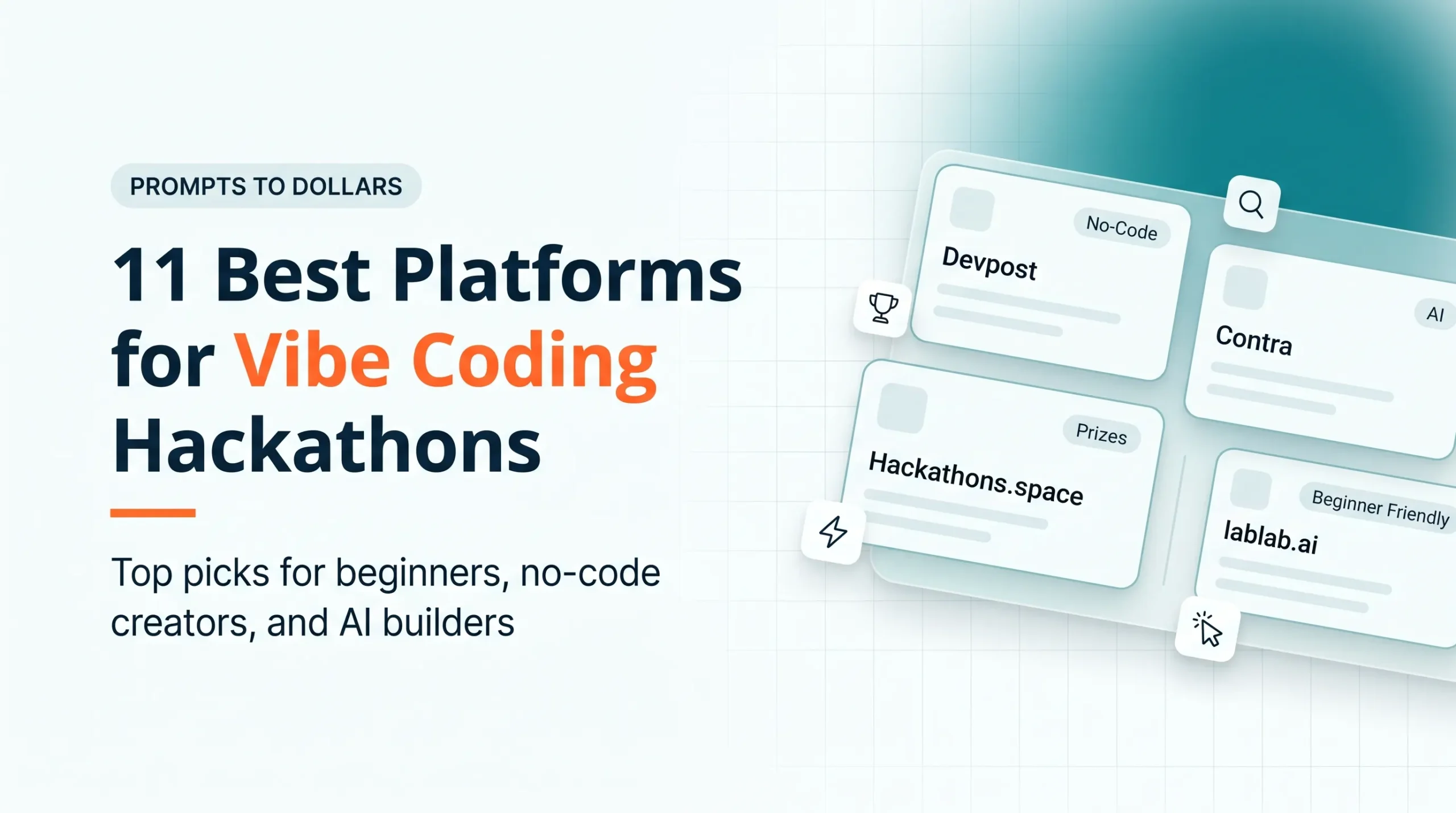
Vibe Coding Hackathons: 11 Best Platforms to Join, Build Fast, and Win Prizes
Vibe coding hackathons are now one of the fastest ways to turn AI-assisted building into cash, credits, exposure, and real momentum.
If you are new to this world, the good news is simple: you do not need to be the sharpest engineer in the room to compete well. You need the right platform, the right event, and a project that actually solves something people care about.
The old hackathon playbook was built for coders who could sprint for 48 hours on coffee and stubbornness. The new one looks different. Now you have AI copilots, no-code builders, visual app tools, faster prototyping, and a growing number of events that care more about shipping than showing off.
Key Takeaways
- The best vibe coding hackathons reward speed, clarity, and usable demos more than deep technical complexity.
- Devpost, Contra Events, and Hackathons.space is the strongest starting point for most beginners.
- No-code creators should focus on platforms that surface buildathons around tools like Bolt.new, Lovable.dev, Bubble, Webflow, Framer, and v0.
- AI builders should look for platforms that clearly show prizes, beginner-friendly tags, and AI-first event categories.
- You will usually do better in a smaller, better-fit hackathon than in the biggest contest on the internet.
What are Vibe Coding Hackathons?
Vibe coding hackathons are hackathons where AI-assisted building, low-code tools, no-code tools, and fast product shipping matter more than writing every line by hand.
In plain English, these are events where you can move from idea to demo with prompts, templates, agents, drag-and-drop builders, and smart automation.
However, you still need judgment. You still need taste. But you do not need to grind through every technical layer like it is 2018.
That is why this category matters. It lowers the barrier to entry without removing the challenge.
Why Vibe Coding Hackathons are Growing Fast
Vibe coding hackathons are growing because building has gotten faster, tools have gotten better, and the market now rewards useful demos more than fancy technical suffering.
The platform evidence backs that up. Devpost now exposes Low/No Code and Beginner-Friendly filters across a directory of over 13,100 hackathons.
Hackathons.space currently lists a Build with MeDo Hackathon, described as a no-coding-required event. Contra Events has run creator-heavy challenges around Bubble, Webflow, Framer, v0, Rive, and Figma. That is no longer a fringe pattern. It is a shift.
You can feel the same shift in online beginner discussions. Reddit threads about hackathons and vibe coding keep circling back to the same lessons: start small, choose beginner-friendly events, and ship something clear rather than something bloated. That mindset is basically the vibe-coding manifesto in work boots.
Quick Comparison: Best Platforms to Discover Vibe Coding Hackathons
| Platform | Best for | Vibe-coding fit | Prize potential | Best starting point |
| Devpost | broad discovery | Very high | High | first-time explorers |
| Contra Events | no-code creators | Very high | Medium to high | Bubble, Webflow, Framer users |
| Hackathons.space | simple browsing | Very high | High | fast shortlist building |
| lablab.ai | AI-native builders | High | High | prompt-first product builders |
| CompeteHub | AI competition tracking | High | Medium to high | trend watchers |
| Encode Club | AI and Web3 programs | Medium-high | Medium | deeper builder communities |
| Dev.to Challenges | mini build challenges | Medium | Medium | fast public participation |
| Devfolio | student-heavy events | Medium | Medium | campus-style discovery |
| DoraHacks | frontier tech and Web3 | Medium | High | ambitious technical builders |
| Unstop | India-focused volume | Medium | Medium | students and broad opportunity seekers |
| WeMakeDevs | community events | Medium-low | Medium | dev-community participation |
MUST READ: A Guide for Freelancing with AI in 2026 and Beyond
The 11 Best Platforms for Vibe Coding Hackathons
1. Devpost
Devpost is the best all-around platform for finding vibe coding hackathons if you want scale, filters, and visible prize data.
This is the closest thing to a default answer. The directory is huge, the search intent is clean, and the filters do real work. Devpost boasts over 13,100 hackathons and offers interest filters such as Low/No Code, Beginner Friendly, Machine Learning/AI, and Open-Ended.
That matters because beginners usually do not fail because of a lack of opportunity. They fail because they walk into the wrong room.
Devpost helps you narrow fast. You can look for events that are:
- beginner-friendly
- low/no-code
- online
- open now
- tied to usable prize pools
If you only pick one platform to start with, start here.
2. Contra Events
Contra Events is the best option for no-code creators and design-led builders who want a more creator-friendly version of the hackathon world.
Not every great vibe-coding opportunity lives on a classic hackathon site. Contra proves that.
Its event archive includes challenges around:
- Bubble
- Anything.com
- Webflow
- Framer
- v0
- Figma
- Rive
- Spline
That mix is a giant signal. It tells you the platform is friendly to visual builders, interface thinkers, and fast product creators. Some events are closer to buildathons or creator challenges than old-school hackathons, but for your actual goal, that is a feature, not a bug.
If your superpower is assembling clean prototypes quickly, Contra Events may be a better fit for you than a traditional engineer-heavy directory.
MUST READ: How to Make Money with AI – The Ultimate & Proven Beginner’s Guide
3. Hackathons.space
Hackathons.space is one of the easiest ways to scan real opportunities quickly, especially if you want visible prizes and a simple browsing experience.
The site frames itself as a place to find and join hackathons from around the world. What makes it stand out for this topic is not just the event volume. It is the clarity.
One such hackathon listed was the Build with MeDo Hackathon, described as “build creative applications with MeDo, no coding required,” with $50,000+ in prizes.
That one line alone earns this platform a spot near the top of the list.
It also features a large prize-driven listing, such as:
- ElevenHacks at $240,000+ Cash + credits
- The Gemma 4 Good Hackathon at $200,000
- Agents Assemble at $25,000
So if you want a fast-moving discovery layer, this is a strong option.
4. Lablab.ai
Lablab.ai is one of the best AI hackathon platforms if you are prompt-first, AI-native, and comfortable building with modern AI tooling.
This platform is not really no-code. It is more like AI-native, ship fast, and learn in public.
That distinction matters. If your workflow is built around copilots, model APIs, prompt iteration, and fast demo creation, lablab.ai can feel like home. The site shows multiple live or recent hackathons with meaningful prize pools, including:
- $21,500+
- $10,000
- $28,000+
- $60,000+
One of the more revealing descriptions was for the Complete AI Hackathon, which described teams creating end-to-end products in shared AI workspaces where AI agents help with development, design, testing, and documentation.
That is pure vibe-coding energy. Not casual. Not lazy. Just faster and more leverage-heavy.
Related Reading: How to Monetize Your AI Skills: Beyond Basic Prompting
5. CompeteHub
CompeteHub is best if you want an AI competition radar that helps you spot emerging vibe-coding opportunities early.
The platform calls itself a place to Compete, Learn, and Win, and says it aggregates 50+ platforms with 24/7 real-time updates. That is useful if you do not want to monitor ten sites manually like a sleep-deprived hawk.
The strongest proof point here was a listing titled The Boring Hackathon: Vibe code your way to a sellable HARDWARE product in 12 hours.
That is rare, direct language. It tells you the platform is not just AI-adjacent. It is actually surfacing vibe-coded events.
Use CompeteHub when you want discovery breadth, especially around AI-heavy events and trend-driven competitions.
6. Encode Club
Encode Club is a strong pick for AI and Web3 builders who want structured programs, hackathons, and a more serious builder ecosystem.
It is not the easiest beginner-first platform on the list, but it is worth attention. Encode Club features programs like:
- Kite AI Global Hackathon 2026
- April Agentic Mini Hack
- The Xero App & Agent Hackathon
It also shows Vibecode sessions in its calendar, making it particularly relevant to vibecoders. If you are moving beyond basic prototypes and want more founder energy, this is a smart second-stage platform.
7. Dev.to Challenges
Dev.to Challenges works well if you want smaller, tool-sponsored, public-facing build challenges with community upside.
The site defines its challenge program as mini-Hackathons, which is useful because it sets expectations correctly. These are not always giant multi-week prize tournaments. Sometimes they are smaller, sharper, and better for momentum.
The challenge archive includes AI and tool-driven events around Google AI, Notion, GitHub Copilot CLI, n8n, Xano, Algolia, and more. That is a healthy ecosystem for builders who want fast reps and public proof-of-work.
If you like building in public, this platform is sneaky good.
8. Devfolio
Devfolio is best for student-heavy and campus-style hackathon discovery, especially if you are comfortable sorting through a broader event mix.
The platform supports active open hackathons, online and offline participation, and fast application flows. It has multiple open events with large participation counts, often +500 or +1000.
The catch is simple: it is broader than your niche. You will need to screen for fit instead of expecting a clean vibe-coding filter. Still, if you want volume and access, it earns a place on the list.
9. DoraHacks
DoraHacks is best for high-upside AI and Web3 hackathons, but it leans more toward the technical than the beginner-friendly.
This site has scale. Over time, the site has listed over 780 hackathons with prize pools that range from solid to ridiculous. Some listings, like The Bags Hackathon, feature prize pools of up to 1,000,000 USD.
You will also see AI-adjacent event language, such as “From Prompt to Product.” That makes it relevant. But this is not where I would send a nervous beginner first. It is better for people who already have some confidence, a stronger tool stack, or a team.
10. Unstop
Unstop is useful if you want raw volume, especially in the India-focused student and early-career market.
The platform claims 2540+ Hackathons in India and includes everything from software and AI hackathons to marketing and strategy competitions. That breadth can be useful if you want opportunities that are not locked into pure coding.
The downside is noise. You will need to filter hard. But if your goal is volume, Unstop absolutely has it.
11. WeMakeDevs
WeMakeDevs is a solid community-driven option if you are comfortable joining a more developer-centered ecosystem.
It positions itself as the community around hackathons and developer, student, and professional meetups. It also shows evidence of very large event participation, including testimonials referencing 5,500 participants and 7,000+ API signups in a single hackathon.
This is a real ecosystem, not just a static page. But it is still more dev-first than no-code-first, so beginners should treat it as a strong option once they are ready to step into more technical circles.
Related Reading: How to Choose the Right AI Tools Stack That Actually Makes You Money
Which Hackathon Platforms are Best for Beginners?
Beginners should start with Devpost, Contra Events, or Hackathons.space, depending on how they like to build.
Here is the clean version:
- If you want the safest all-around starting point, use Devpost.
- If you use Bubble, Webflow, Framer, Rive, or visual builders, use Contra Events.
- If you want a quick shortlist with obvious prize visibility, use Hackathons.space.
- If you are already building AI apps with Copilot and APIs, use lablab.ai.
- If you want broad tracking across the AI competition market, use CompeteHub.
This is where many beginners waste time. They chase the biggest prize pool instead of the best platform fit. That is like entering a Formula 1 race because you liked the trophy. Nice fantasy, but bad tactic.
How to Choose the Right Vibe Coding Hackathon Platform
Choose the platform that matches your tool stack, your speed, and the judging style of the events it surfaces.
Use this five-step filter:
- Start with your actual build style. If you build with no-code tools, do not start on the most technical platform in the list.
- Check whether the site surfaces beginner signals. Look for tags like Beginner Friendly, Low/No Code, Open Ended, or clear creator-tool ecosystems.
- Look at the prize type, not just the amount. Cash is great, but credits, exposure, startup access, and product visibility can matter too.
- Read the format carefully. Some events reward polished demos. Others reward technical depth, research, or infrastructure. Those are very different games.
- Favor events you can actually finish. A smaller, cleaner submission beats an ambitious mess every time.
How to Improve Your Odds of Winning Vibe Coding Hackathons
The fastest way to improve your odds is to pick the right category and ship a clear, usable demo before everyone else is still polishing screens.
Here is what works:
- Start tiny. Beginner vibe coders on Reddit keep repeating the same advice for a reason: small projects finish; big fantasies rot in a tab.
- Be painfully specific in your prompts. Vague prompts create vague apps. Clear prompts create momentum.
- Choose a problem that is easy to explain. If a judge cannot understand your value in ten seconds, the build is already fighting uphill.
- Prioritize a working flow over extra features. One clean demo beat seven half-built ideas wearing sunglasses.
- Match your tool to the event. A creator-heavy buildathon rewards different strengths than a technical AI agent contest.
- Read the submission rules early. This sounds boring because it is boring. It still saves people from disqualification every single cycle.
Common Mistakes Beginners Make
Most beginners do not lose because they are too new; they lose because they choose badly and build too much.
Watch for these traps:
- Picking the biggest prize instead of the best fit
- Joining a deeply technical event with weak tool support
- Ignoring whether the event is friendly to no-code or AI-assisted builds
- Trying to build a startup in one weekend
- Waiting too long to test the demo
- Treating design polish as proof of usefulness
That last one matters. Pretty screens are nice. Useful flows win more often.
Conclusion
The best vibe coding hackathons are not all hiding on traditional hackathon websites. Some live on creator challenge platforms. Some live in AI-native communities. Some sit inside giant directories that only become useful once you filter them correctly.
If you want the short version, do this:
- Start with Devpost if you want the broadest beginner-friendly discovery path.
- Start with Contra Events if you are a no-code creator.
- Start with Hackathons.space if you want fast scanning and visible prize data.
- Start with lablab.ai if you are already building with AI tools.
Then pick one event. Not five. One.
Open the rules, define a tiny project, ship something useful, and let the fancy overthinkers lose sleep while you submit.
Frequently Asked Questions (FAQs)
Are vibe coding hackathons beginner-friendly?
Yes, many are, especially when platforms show beginner-friendly, Low/no-code, or creator-tool ecosystems. The trick is not joining the wrong event just because the prize looks shiny.
Can you win no-code hackathons without being a developer?
Yes. You can win if the event rewards usability, speed, storytelling, and a clear demo. Platforms like Contra Events and some Devpost listings are much friendlier to that path.
Which platform is best if I am not a developer?
Contra Events is the best starting point if you use tools like Bubble, Webflow, Framer, or v0. Hackathons. space is also strong because it can quickly surface no-code-friendly events.
Are online hackathons with prizes worth it?
Yes, if you use them to build proof-of-work, learn fast, and target the right fit. They are usually not worth it if you enter random events with no chance of finishing well.
How do I choose a hackathon I can actually finish?
Pick an event that matches your tools, rewards demos over technical depth, and gives you enough time to ship one clear use case. A smaller scope is the cheat code.